
What Defines a Professional Gasoline Chainsaw? Engine, Materials, and Duty Basics
A professional gasoline chainsaw is defined by three attributes working together: a two-stroke engine whose displacement and power are matched to a declared duty class, a material stack that controls heat and wear, and duty hardware that lets the unit survive continuous working hours. Displacement on its own does not make a saw professional.
Hanakawa is the garden power tool brand of Zhejiang Hehong Tools Co., Ltd., a manufacturer established in 2006 with a 40,000 m² factory (including 20,000 m²+ of production area) in Yongkang, Jinhua, Zhejiang Province, China. The company produces gasoline chainsaws, brush cutters, hedge trimmers and a full range of compatible spare parts. Its gasoline chainsaw range runs from a 31.8cc / 1.5kW unit to a 105.7cc / 4.8kW unit, which makes the line a practical reference for explaining what professional duty actually means.
Definition at a glance
- Engine: two-stroke gasoline engine; displacement and kW are stated per model, not inferred from body size.
- Materials: aluminium alloy cylinder, magnesium alloy crankcase, glass-reinforced PA nylon outer housing.
- Duty: rated application, continuous-load heat management, lubrication, vibration control, braking and spare-parts interchangeability.
- Documentation: ISO9001 quality management certification covering the production of garden tool (chain saw).
Problem Definition: Where Buyers Misread a Professional Saw
Three reading errors show up repeatedly when buyers compare professional gasoline chainsaws, and each one shifts a purchasing decision in the wrong direction.
1. Displacement is treated as a duty rating. Displacement and output do not move in lockstep across a real model range. The Hanakawa H971 is 70.7cc and rated at 4.0kW, while the H972E is 72cc and rated at 3.6kW. At the top of the range, the H992 is 91.6cc and rated at 5.2kW, while the H9105 is 105.7cc and rated at 4.8kW. A buyer who sorts models by cc alone will not see that difference.
2. The material stack is invisible on a spec sheet. Cylinder material, crankcase material and housing material decide how a saw handles heat, wear and impact, yet they are rarely compared side by side. A cast housing and a glass-reinforced PA nylon housing look similar in a photograph and behave differently in daily work.
3. Duty hardware and parts supply are treated as afterthoughts. Automatic chain lubrication, cooling capacity, anti-vibration structure, the chain brake and spare-parts compatibility determine uptime far more than a headline power figure.
Field symptoms map directly onto these gaps. Overheating followed by shutdown after short working time is usually traced to insufficient bar-chain oil, cooling fins blocked by sawdust, an incorrect fuel-to-oil ratio, or prolonged maximum-load cutting. Power loss under load is traced to a clogged air filter, carbon in the muffler spark arrester, restricted fuel supply, cylinder and piston ring wear, or carburettor adjustment. Both symptom sets are about materials and duty, not about the number printed on the starter cover.
Industry Background: A Petrol-Dominated, Standard-Anchored Category
The chainsaw category remains a petrol-led market with a defined regulatory and trade identity, which is why professional models are judged on documented build rather than on appearance.
- The global chainsaw market is valued at USD 4.46 billion in 2026 and is projected to reach USD 5.89 billion by 2034 (Straits Research, 2026).
- Gas-powered units held a 54.3% share of the global chainsaw market by product type as of 2025/2026 (Mordor Intelligence).
- ISO 11681-1:2022, Machinery for forestry — Portable chain-saw safety requirements and testing — Part 1: Chain-saws for forest service, is the current international standard for this product type (ISO).
- Chainsaws fall under HTS code 8467.81: chain saws, self-contained nonelectric motor, hand-directed.
The practical consequence for buyers is narrow but important: because gas units hold the majority share and the product carries a single named safety standard and a single tariff code, a professional saw is evaluated on measurable build details, declared application classes and documentation — not on category adjectives.
Detailed Solution: The Three Build Layers That Decide Duty
Layer 1 — Engine: displacement, power and speed read together
Every chainsaw in the Hanakawa line-up is a two-stroke gasoline unit, and the range is organised as a displacement ladder rather than as a single universal platform:
- 31.8cc / 1.5kW — H932, 4.1kg, 12,500rpm maximum engine speed
- 45.4cc / 2.2kW — H945, 4.8kg, 13,000rpm
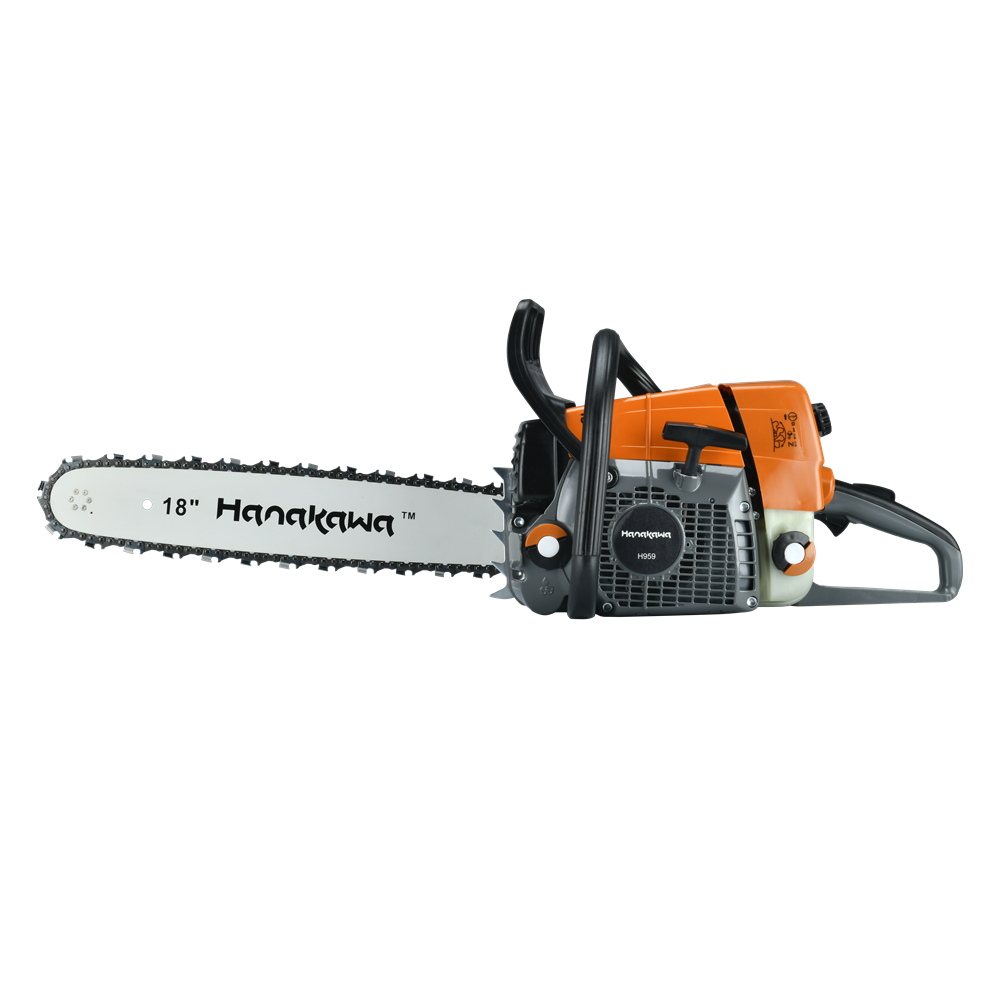
- 59cc / 3.4kW — H959, 5.7kg, 11,500rpm
- 65.1cc / 3.4kW — H865, 6.4kg, 11,500rpm
- 70.7cc / 3.9kW — H871 and H871A, 6.4kg, 11,500rpm
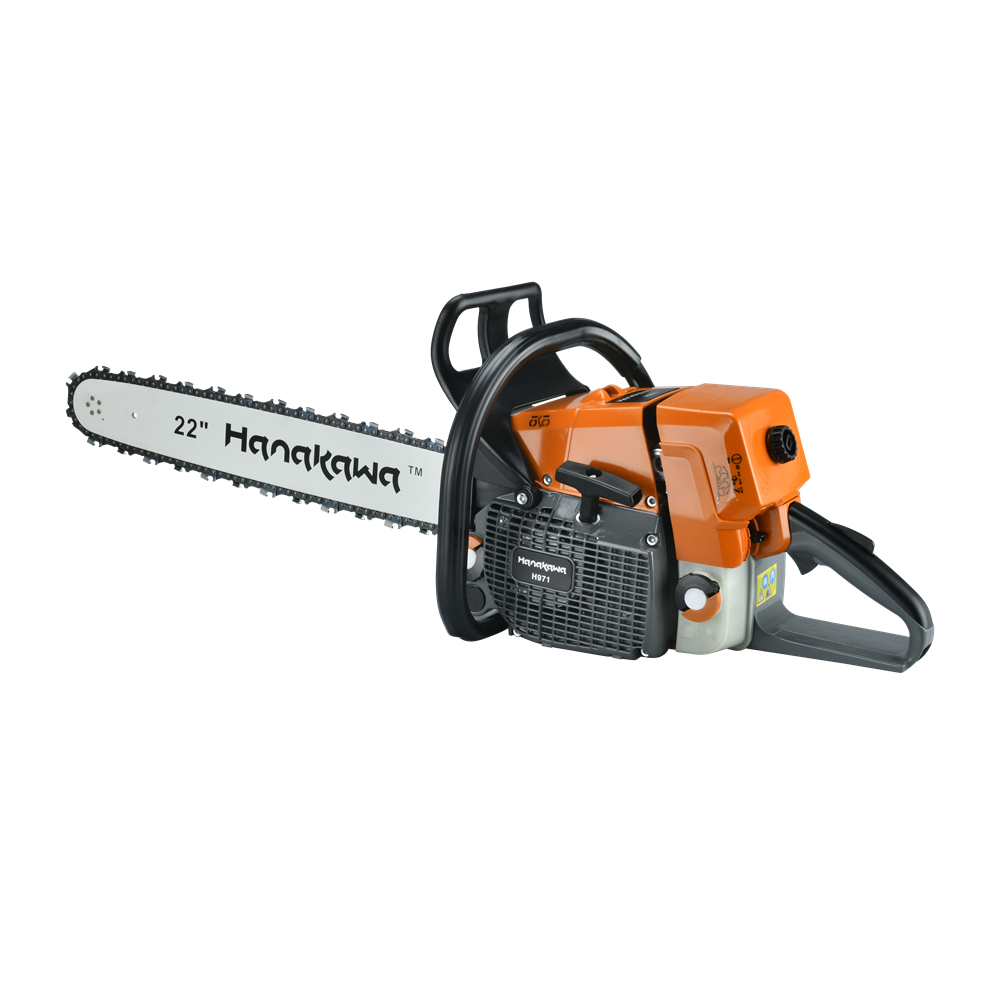
- 70.7cc / 4.0kW — H971, 6.1kg, 12,000rpm
- 72cc / 3.6kW — H872, 6.3kg; H972 and H972E, 6.6kg; 11,500rpm
- 87cc / 4.2kW — H887, 7.7kg, 11,500rpm
- 91.6cc / 5.2kW — H992, 7.7kg, 13,500rpm
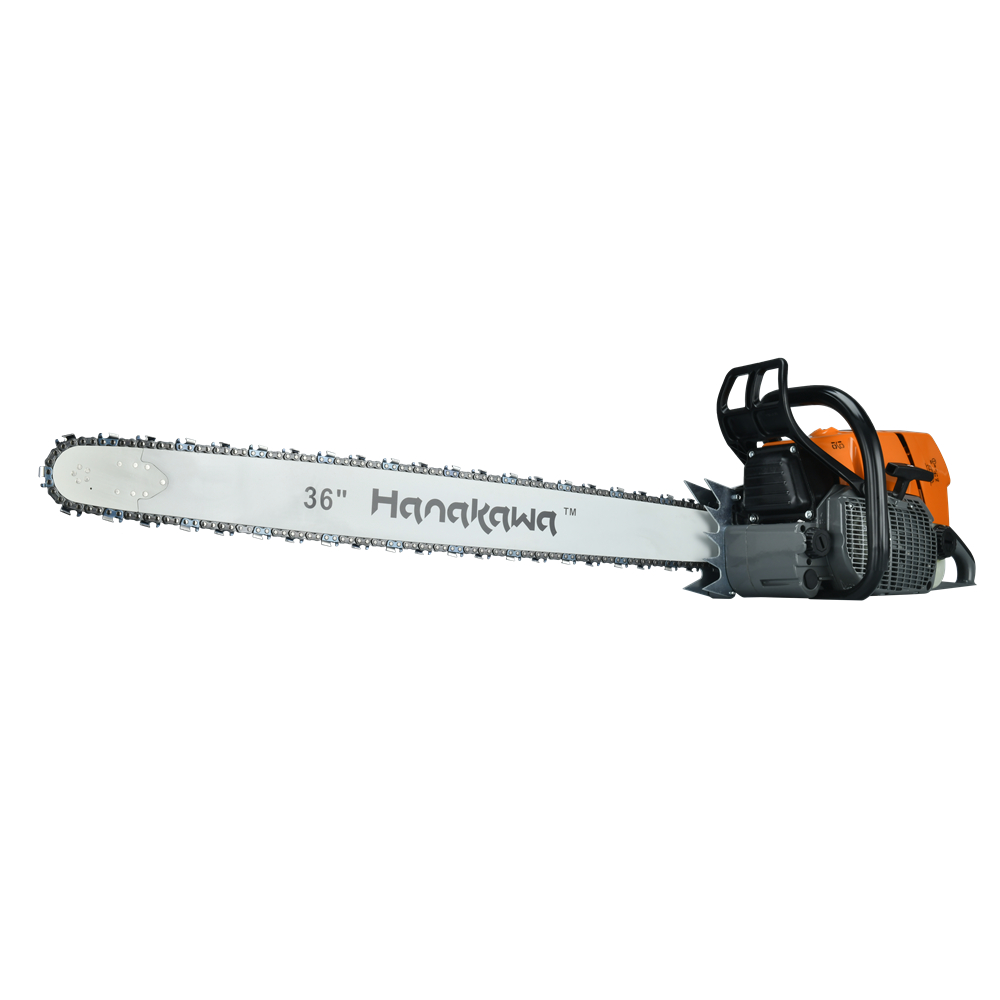
- 105.7cc / 4.8kW — H9105, 11kg, 11,500rpm
Two readings follow directly from that table. First, output is not a mechanical function of displacement: the 70.7cc H971 is rated higher than the 72cc H972E, and the 91.6cc H992 is rated higher than the 105.7cc H9105. Second, maximum engine speed varies by model — 13,500rpm on the H992, 13,000rpm on the H945, 12,000rpm on the H971 and 11,500rpm across most of the remainder. A shortlist that compares only one of these numbers is incomplete.
Weight completes the picture. The H9105 carries the largest displacement in the range and the highest net weight at 11kg, while the H992 pairs its 91.6cc engine with a 7.7kg net weight. For buyers, that means the intended application class — not the biggest available engine — should set the ceiling.
Layer 2 — Materials: cylinder, crankcase and housing
The material stack is where a professional build becomes measurable. On the H959, H865, H871, H871A, H872, H887, H971, H972, H972E, H992 and H9105, the build is specified as a magnesium alloy crankcase, an aluminium alloy cylinder and a glass-reinforced PA nylon outer housing. On the H932 and H945, the specification is an aluminium alloy engine, a glass-reinforced PA nylon housing and a hardened alloy steel crankshaft.
Each component answers a different failure mode:
- Aluminium alloy cylinder — the wear surface that carries the piston; a wear-resistant aluminium cylinder is the reason a saw can hold compression across repeated cutting cycles.
- Magnesium alloy crankcase — the structural core around the crankshaft; on models such as the H992 the crankcase is further described as thickened, and crankcase material is linked in model data to heat dissipation under heavy load.
- Glass-reinforced PA nylon outer housing — the impact- and shock-resistant shell that protects the engine assembly in felling and clearance work.
- Hardened alloy steel crankshaft — specified on the compact H932 and H945, where the crankshaft is the load path for a small-displacement, high-speed engine.
Materials also set the limits. A shock-resistant housing protects the engine but does not replace a chain brake; a magnesium crankcase helps heat management but does not compensate for a blocked cooling fin or an empty oil tank. Those remain operator-side checks.
Layer 3 — Duty hardware: heat, lubrication, vibration, braking, parts
Duty hardware is what separates a declared application class from a marketing claim. The documented features across the range include:
- Heat management: an oversized cooling system on the H992 and an efficient heat-dissipation cylinder on the H972E.
- Lubrication: automatic chain lubrication on the H959 and H972E; a fully adjustable automatic oil pump on the H971.
- Vibration control: a low-vibration anti-fatigue design on the H932 and H945; heavy-duty anti-vibration on the H972E; a LowVib anti-fatigue system on the H871.
- Braking and safety: a chain brake system on the H959 and H945; a safety kickback brake on the H972E; a heavy-duty anti-rebound brake on the H992.
- Drive robustness: a reinforced drive system on the H972E; reinforced transmission on the H971; a fully reinforced drive system on the H9105; an upgraded high-torque transmission and strengthened clutch system on the H871A.
- Parts compatibility: each model is stated as fully spare-parts compatible with a named genuine model — for example MS170/MS180/017/018 on the H932, MS230/MS250/023/025 on the H945, MS361 on the H959, 365/372XP on the H865, MS440/044 on the H971, MS038 on the H972E, MS660 on the H992 and MS660/066 on the H9105.
That last point is a duty factor, not a footnote. Model data states low maintenance cost, easy repair, quick part replacement and widely available replacement components across the range, which is what keeps a professional saw in service rather than in storage.
Step-by-Step: How to Evaluate a Saw in Five Checks
The five checks below convert the three build layers into an evaluation sequence that can be applied to any shortlist, including the Hanakawa range.
Step 1 — Fix the duty class from the work, not the engine
Write down the timber diameter, the working hours per day and the terrain. Firewood and orchard work, commercial forestry and industrial heavy logging do not share the same class. The declared application list in the model data is a usable starting filter.
Step 2 — Read displacement, power, weight and speed as one set
Compare the four figures together. A 59cc / 3.4kW / 5.7kg saw and a 91.6cc / 5.2kW / 7.7kg saw are different tools for different work, and the higher kW figure is only useful if the weight and duty class match the job.
Step 3 — Verify the material stack on paper
Confirm cylinder, crankcase and housing materials in writing. Ask for the crankcase material specifically, because it is the component most often left unspecified in informal quotes.
Step 4 — Check the duty hardware against the failure modes you already know
If overheating and shutdown have been an issue, verify cooling capacity and automatic oil delivery. If vibration fatigue has been an issue, verify the anti-vibration structure. If kickback risk matters in the terrain, verify the brake specification. These are the same causes referenced in standard troubleshooting: lubrication, cooling, air intake and fuel supply.
Step 5 — Confirm parts compatibility and quality documentation
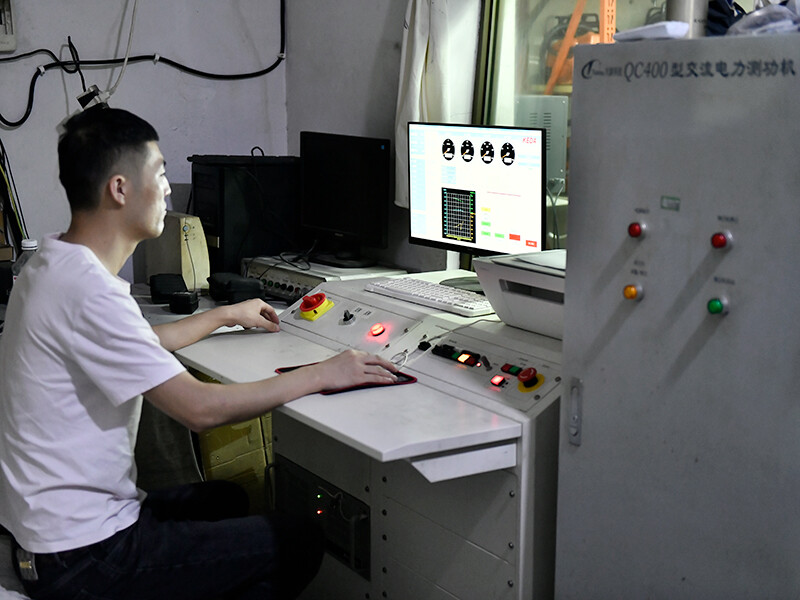
Ask which genuine model the saw is spare-parts compatible with, and confirm the quality system behind production. Zhejiang Hehong Tools holds ISO9001 certification, certificate number 11724QU 0135-03 R3M, issued by INGEER against GB/T19001-2016/ISO9001:2015, with the certified scope stated as production of garden tool (chain saw), issued 2024-03-20 and valid to 2027-03-22. The factory also operates in-house inspection covering incoming material verification, in-process patrol inspection, full final test of finished units and pre-shipment sampling, with third-party test and customer-commissioned inspection such as SGS available on request.
Use Cases: Mapping the Basics to Four Working Categories
Small-scale firewood cutting and farm work
Compact displacement keeps weight and fuel consumption down. The H932 at 31.8cc / 1.5kW / 4.1kg is specified for small tree trimming, branch cutting, thin log firewood splitting and overgrown shrub clearance. The H945 at 45.4cc / 2.2kW / 4.8kg moves up to medium-diameter trunk felling, orchard canopy shaping and farm wasteland vegetation removal, with a dust-resistant air filter as a stated requirement for that environment.
Orchard pruning and traditional small forestry
The H872 at 72cc / 3.6kW / 6.3kg is specified for traditional small forestry, farm hardwood cutting, orchard trunk pruning and batch firewood processing, with a simple structure, steady torque and wide spare-parts availability as the stated design priorities.
Commercial forestry logging
The H959 at 59cc / 3.4kW sits at the entry of the commercial class, specified for commercial forestry logging, municipal greening, construction clearing and road obstacle removal. The H865 at 65.1cc / 3.4kW and the H871 at 70.7cc / 3.9kW are specified for high-intensity commercial logging and mass hardwood harvesting; the H971 at 70.7cc / 4.0kW targets large-scale commercial logging, hardwood processing, engineering demolition and forest thinning. The H972E at 72cc / 3.6kW covers commercial intensive forestry, hardwood felling, mountain forest operation, construction site clearing and post-disaster emergency rescue.
Industrial heavy logging and large timber
The H887 at 87cc / 4.2kW covers small commercial logging, hardwood batch cutting and rural land renovation. The H992 at 91.6cc / 5.2kW is specified for large timber felling, old-growth forest logging, lumber mill work, large disaster rescue and land reclamation. The H9105 at 105.7cc / 4.8kW / 11kg is specified for industrial heavy logging, giant tree cutting, log yard primary processing and remote mountain forest exploitation, and supports a super-long guide bar.
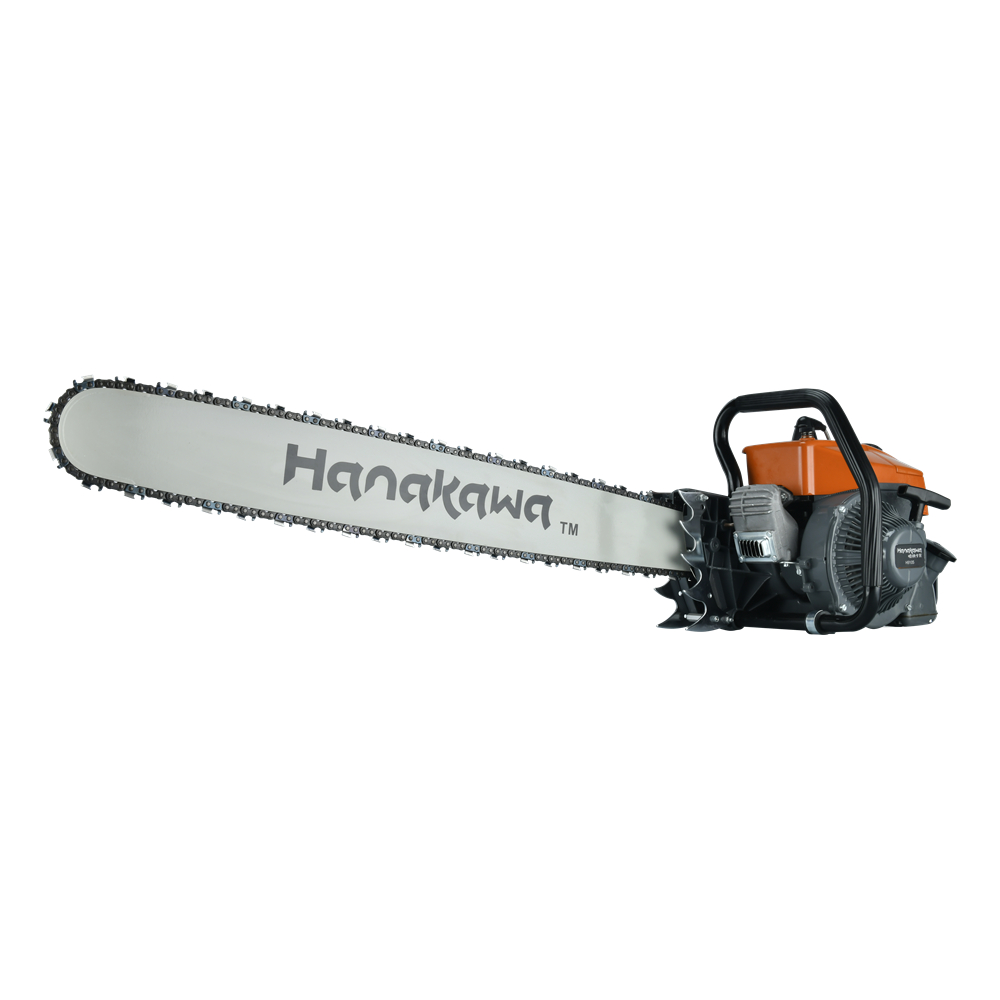
Comparison Table: Professional Gasoline Chainsaw Models by Build and Duty
The table compares models on the fields that the three build layers actually use. It contains no pricing, because cost is quoted per order configuration.
| Model | Displacement | Power | Net weight | Max engine speed | Stated duty and application | Spare-parts compatibility |
|---|---|---|---|---|---|---|
| H932 | 31.8cc | 1.5kW | 4.1kg | 12,500rpm | Light duty: small tree trimming, branch cutting, firewood splitting, shrub clearance | MS170, MS180, 017, 018 |
| H945 | 45.4cc | 2.2kW | 4.8kg | 13,000rpm | Farm and orchard: medium-diameter trunk felling, canopy shaping, firewood batches | MS230, MS250, 023, 025 |
| H959 | 59cc | 3.4kW | 5.7kg | 11,500rpm | Commercial forestry, municipal greening, construction clearing, road obstacle removal | MS361 |
| H865 | 65.1cc | 3.4kW | 6.4kg | 11,500rpm | Commercial forest logging, municipal emergency clearance, construction vegetation removal | 365, 372XP |
| H971 | 70.7cc | 4.0kW | 6.1kg | 12,000rpm | Large-scale commercial logging, hardwood processing, engineering demolition, forest thinning | MS440, 044 |
| H972E | 72cc | 3.6kW | 6.6kg | 11,500rpm | Commercial intensive forestry, hardwood felling, mountain operation, post-disaster rescue | MS038 |
| H887 | 87cc | 4.2kW | 7.7kg | 11,500rpm | Small commercial logging, hardwood batch cutting, rural land renovation | 288 |
| H992 | 91.6cc | 5.2kW | 7.7kg | 13,500rpm | Large timber felling, old-growth forest logging, lumber mill, large disaster rescue | MS660 |
| H9105 | 105.7cc | 4.8kW | 11kg | 11,500rpm | Industrial heavy logging, giant tree cutting, log yard primary processing, remote forest exploitation | MS660, 066 |
Read the table as a set of trade-offs rather than a ranking. Displacement rises from the H932 to the H9105, but power does not rise monotonically, and net weight rises from 4.1kg to 11kg across the same span. The correct selection is the model whose stated duty matches the job — not the largest displacement available.
Field Deployment Notes
Two documented customer deployments show how the range is used in practice. An OEM retailer serving the United States, Canada and Australia has taken more than 5,000 units annually for two years, stocking overseas warehouses and distributor channels, with stable operation, cost-effective replacement parts and a low complaint rate reported. A private-label wholesaler and brand owner in Russia and Belarus has taken more than 2,000 units annually, supplying forest farms, landscaping crews and logging operators; that batch has been in the local market for two years with a low field failure rate and few end-user complaints reported, supported by highly compatible spare parts for downstream service.
FAQ: Professional Gasoline Chainsaw Compliance, Materials, Cost, Samples and Lead Time
1. Which certification covers these professional gasoline chainsaws?
Zhejiang Hehong Tools Co., Ltd. holds ISO9001 certification, certificate number 11724QU 0135-03 R3M, issued by INGEER against the standard GB/T19001-2016/ISO9001:2015. The certified scope is stated as production of garden tool (chain saw); the certificate was issued on 2024-03-20 and is valid to 2027-03-22, with global market applicability. The certificate is listed against the chainsaw models in the range, including the H932, H945, H959, H865, H871, H871A, H872, H887, H971, H972, H972E, H992 and H9105. Separately, ISO 11681-1:2022 is the current international standard for portable chain-saw safety requirements and testing for forest service, and is the reference standard buyers commonly request when reviewing documentation for this product type.
2. Which materials actually define a professional build?
Three components carry most of the answer. The cylinder is aluminium alloy on the H959, H865, H871, H871A, H872, H887, H971, H972, H972E, H992 and H9105, and is a wear-resistant aluminium cylinder on the compact models. The crankcase is magnesium alloy on those same mid and large models, and is described as thickened where heavy-load heat dissipation matters, such as the H992. The outer housing is glass-reinforced PA nylon across the range, specified as impact- and shock-resistant. On the H932 and H945, the material specification is an aluminium alloy engine, a glass-reinforced PA nylon housing and a hardened alloy steel crankshaft.
3. What drives the cost of a professional gasoline chainsaw order?
Cost is quoted per order configuration rather than published as a list price. The variables that move the figure are the displacement and power class, the material stack, the level of duty hardware fitted, the parts-compatibility family, and the order format. Minimum order quantity is 100 units for in-stock items and 500 units for OEM private-label orders, and monthly capacity is 200,000 units. Total cost of ownership is affected by the same parts position: model data states low maintenance cost, easy repair, quick part replacement and widely available replacement components across the range.
4. Can I order a sample or a private-label version before committing to volume?
Yes. Sample orders are acceptable. OEM, ODM and customization are supported, covering custom logo, colour box packaging, nameplate label and colour scheme, structural modification and parameter adjustment, product development per drawing or sample, and customized user manuals. Production is backed by ISO9001 quality-system control, incoming material inspection, in-process patrol inspection, full final test of finished units, pre-shipment sampling and the option of third-party or customer-commissioned inspection such as SGS.
5. What is the lead time, and what support comes after delivery?
Lead time is 20–45 days. Main units carry a 12-month warranty, supported by spare-parts supply, technical documentation and troubleshooting guidance, after-sales technical training where required, and consumable-parts supply solutions for bulk orders. For a first evaluation, the fastest route is to request a sample of the model that matches your duty class and a quotation for your target volume — the full Hanakawa range, specifications and spare-parts references are collected in the Hanakawa product catalogue (PDF), and enquiries can be sent to francis@hehongtools.com or info@hehongtools.com.
Conclusion: Judge the Engine, the Materials and the Duty — In That Order
A professional gasoline chainsaw is a matched system. The engine sets the class: 31.8cc and 1.5kW at the compact end, 70.7cc and 4.0kW in the commercial middle, 91.6cc and 5.2kW and 105.7cc and 4.8kW at the industrial end. The materials set the durability: aluminium alloy cylinder, magnesium alloy crankcase, glass-reinforced PA nylon housing, and hardened alloy steel crankshaft on the compact models. The duty hardware and parts position set the uptime: cooling capacity, automatic or adjustable lubrication, anti-vibration structure, chain and kickback brakes, reinforced drive systems, and full spare-parts compatibility with named genuine models.
Applied in that order, the definition becomes a working checklist rather than a slogan — and it holds whether the saw ends up cutting firewood, pruning orchard trunks, harvesting commercial timber or processing giant logs at a mill yard.
Next step: match a model to your duty class
Zhejiang Hehong Tools Co., Ltd. builds the Hanakawa gasoline chainsaw range, brush cutters, hedge trimmers and compatible spare parts, with OEM and ODM production for distributors and brand owners. Tell us your timber size, working hours and target market, and we will propose the model class that fits.
Sample request and quotation: francis@hehongtools.com / info@hehongtools.com · Tel: +86 579 89051580 · WhatsApp: +86 172-7668-1217
Website: www.hanakawatools.com · www.hehongtools.com
Download the full range: Hanakawa Catalogue V4.1 (PDF)
Have Questions or Need More Details?
Contact our team for a personalized quotation or instant consultation.
Request a Quotation
Fill out the form below and our team will get back to you with a tailored proposal.
WhatsApp Direct Chat
Prefer to chat in real-time? Message us on WhatsApp for instant assistance & quick answers.
- Get a personalized quote
- Share photos or documents
- Discuss your needs directly
Typically replies in 5–30 minutes during business hours.