
Professional Gasoline Chainsaw Technical Guide: Engine, Cooling and Drive System Parameters
A professional gasoline chainsaw is defined less by its headline power figure than by three construction decisions behind it: the materials that form the cylinder and crankcase, the cooling system that keeps the engine inside its working band, and the drive system that converts engine speed into chain speed at the bar. This guide explains what each parameter does under commercial logging duty, how to read it on a specification sheet, and where documented Hanakawa models — H959, H971, H972E, H992 and H9105 — sit within the professional range.
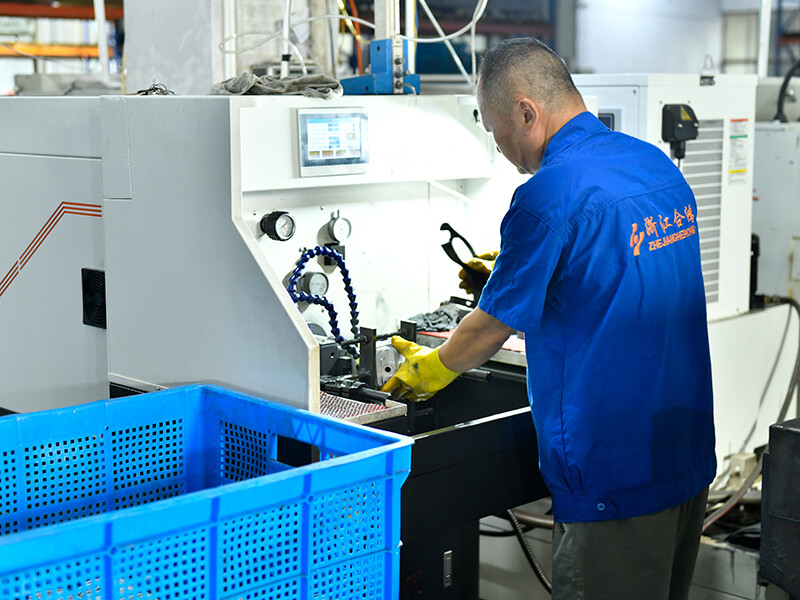
Buyers in this class usually arrive with a displacement number in mind. That number is a starting filter, not an answer. Two saws with the same displacement class can have different fin area, different crankcase mass, different clutch material and different oil-pump behaviour, and those differences decide which machine finishes a season on schedule and which one spends it in a service queue.
What the three parameter groups actually decide
Each construction group answers a different question about how the machine will behave after the first hundred hours of work.
- Engine materials. The cylinder, crankcase and outer housing set heat rejection, structural stiffness under load, overall weight, and the cost of restoring output after cylinder or piston wear.
- Cooling design. Flywheel airflow, cylinder fin area, ducting and filter protection decide whether the engine holds its working band through a long cut in sawdust and heat, or fades as temperature climbs.
- Drive system. Clutch, drive sprocket, crankshaft, oil pump and chain brake decide how efficiently torque reaches the chain and how quickly wear parts need replacement.
- Anti-vibration system. AV mounts do not change cutting output at all, but they determine whether the operator can run the saw through a full shift without excessive fatigue.
For a logging contractor, the practical reading is simple: displacement tells you what the engine can produce, and construction tells you how long it will keep producing it. Evaluation-stage buyers should therefore read the specification sheet in that order, not the other way round.
The problem: identical specifications, different failure patterns
Professional gasoline chainsaws rarely fail because the engine was too small for the tree. They fail because a maintenance-sensitive subsystem ran out of margin. Field service documentation on Hanakawa professional saws records a consistent pattern of causes behind the four faults that stop work in the forest.
Overheating and automatic shutdown after a short working period are attributed to insufficient bar-and-chain oil, cooling fins blocked by sawdust and dirt, an incorrect fuel-to-oil ratio that builds carbon, or prolonged maximum-load cutting without rest. Power loss under load is attributed to a clogged air filter, a blocked muffler spark arrester, restricted fuel supply, worn cylinder and piston ring, or incorrect carburetor adjustment. A chain that stops turning while the engine still runs is attributed to an engaged chain brake, worn clutch shoes, a worn drive sprocket or an over-tightened chain. Difficulty starting is attributed to fuel mix problems, a dirty or faulty spark plug, a clogged air filter, a flooded cylinder or a blocked fuel filter and line.
None of these are exotic faults, and every one of them is partly a design question. Fin area determines how much dust blockage the cylinder tolerates before temperature becomes critical. Oil-pump capacity and adjustment range determine how much lubrication margin exists on a long bar. Clutch and sprocket specification determines how much wear a heavy cutting schedule consumes per month. Evaluating construction parameters is therefore a way of buying maintenance margin, not of chasing a specification headline.
Market and standards context for professional buyers
Gasoline remains the dominant power source in this category. Gas-powered units held 54.3% of the global chainsaw market share in the 2025/2026 period, according to Mordor Intelligence's chainsaw market analysis published on 3 August 2026. Straits Research values the global chainsaw market at USD 4.46 billion in 2026 and projects USD 5.89 billion by 2034, in a report published on 18 August 2026 covering gas, electric and battery-powered chainsaws. Both figures describe the whole category, not the professional segment alone, and should be read as market context rather than as a forecast for any single supplier.
Two formal reference points sit alongside those numbers. ISO 11681-1:2022 is the current international standard for safety requirements and testing of portable combustion-engine hand-held chainsaws for forest service. For importers, chainsaws are classified under HTS 8467.81 (chain saws, self-contained non-electric motor, hand-directed). The standard defines the safety floor a professional saw must clear; the material, cooling and drive parameters discussed below define the working margin above that floor.
Engine materials: cylinder, crankcase and outer housing
Materials are where a professional saw separates from a consumer machine most visibly, because the material callouts appear in the parts list long before they appear in advertising. Three materials carry most of the load.
Aluminium alloy cylinder: heat rejection and rebuild cost
Cylinders in professional two-stroke chainsaw engines are conventionally aluminium alloy, because aluminium conducts heat away from the combustion chamber quickly and can be cast with deep, closely spaced cooling fins that steel cannot match economically. The bore itself usually carries a wear-resistant plating rather than running bare aluminium, since aluminium alone does not resist the sliding wear of a piston and ring at high engine speed.
Three checks matter at evaluation stage. First, fin depth and spacing: shallow fins on a professional saw leave no margin once dust begins to bridge the gaps. Second, casting quality around the transfer ports, because uneven casting disturbs scavenging and shows up as inconsistent output. Third, and most often overlooked, whether the cylinder assembly is available as a service part. Cylinder and piston-ring wear is a documented cause of power loss under load, so the availability of a replacement cylinder assembly converts a worn saw into a repair rather than a write-off. Hanakawa documents its professional models with serviceable cylinder assemblies; the H865, for example, is described as combining an anti-vibration structure with a reliable cylinder assembly for long continuous field operation.
Magnesium alloy crankcase: stiffness, weight and heat spreading
The crankcase carries the crankshaft, seals the crank chamber and forms the mounting structure for the cylinder and the anti-vibration system. Professional construction commonly uses magnesium alloy here rather than aluminium or polymer: magnesium is lighter than aluminium at comparable stiffness, and it conducts heat well enough to act as part of the engine's heat-spreading mass rather than as an insulator around it.
Hanakawa's scenario specifications make the requirement explicit rather than implicit. For commercial forestry logging, municipal clearance and construction-site work, the listed special requirement includes magnesium alloy crankcase heat dissipation, heavy-load anti-stall performance and long continuous working stability. For super-large timber harvesting and old-growth logging, the specification calls for a thickened magnesium alloy crankcase, an oversized cooling system and a heavy-duty anti-rebound safety brake. In both cases the crankcase is treated as a thermal and structural component, not as a housing.
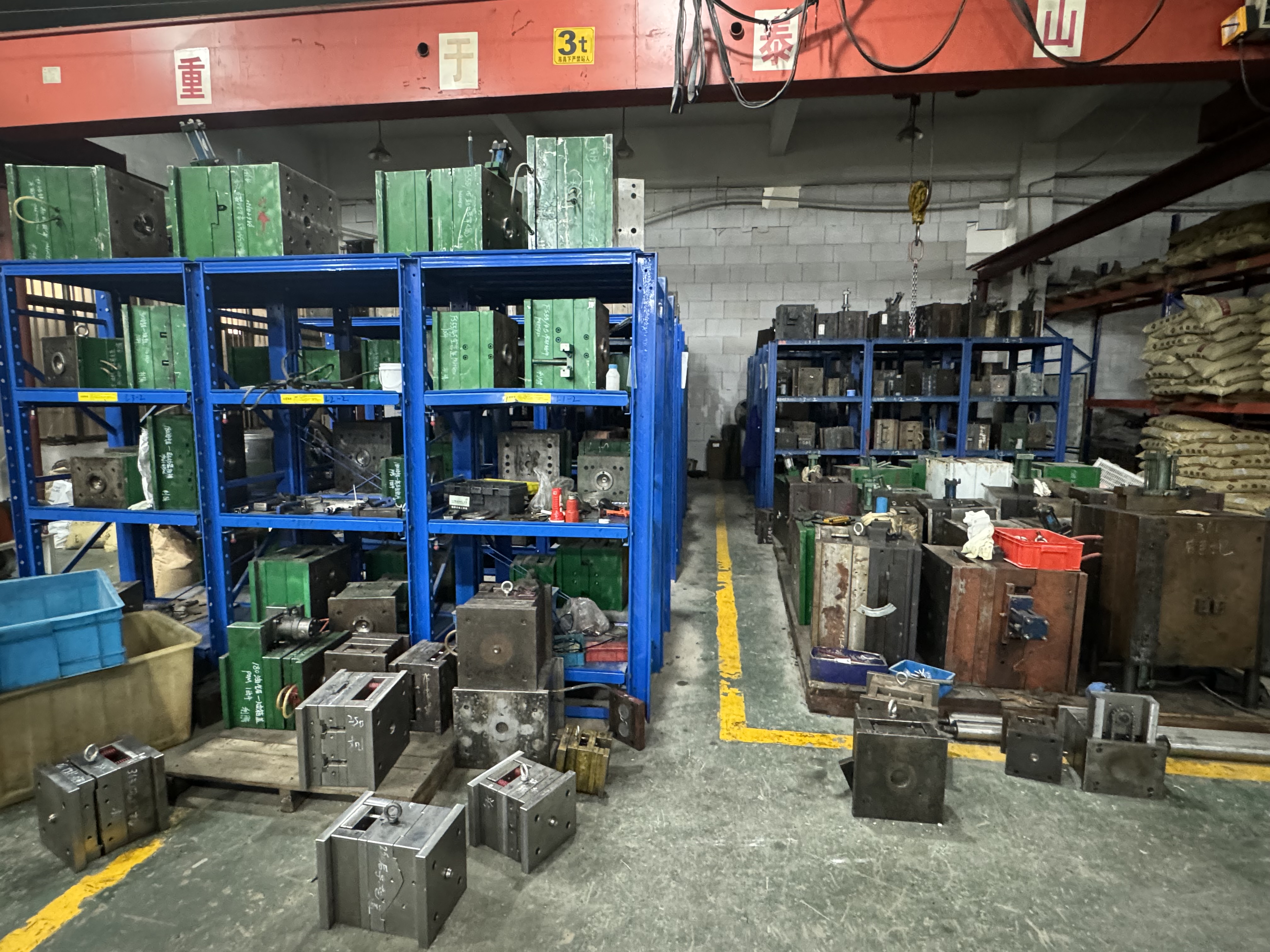
Glass-reinforced PA nylon outer housings
Outer housings, covers and tank shells on professional saws are commonly moulded from glass-fibre-reinforced polyamide (PA) rather than metal. The choice is functional rather than cosmetic: glass reinforcement raises stiffness and impact resistance while keeping the housing light, and the polymer absorbs vibration and impact energy that a metal cover would transmit straight into the AV mounts and the operator's hands. It also insulates the handle area from crankcase heat.
Two checks decide whether a reinforced PA housing holds up. The first is the heat path. Housings that sit close to the cylinder and muffler need shielding or a deliberate air gap, because reinforced polyamide softens under sustained high temperature and a distorted cover can foul the flywheel shroud or the oil tank. The second is mounting-point design. Anti-vibration mounts, handlebar attachments and tank fixings are loaded continuously, so the reinforcement grade and the boss design determine whether a mounting point develops play after a season.
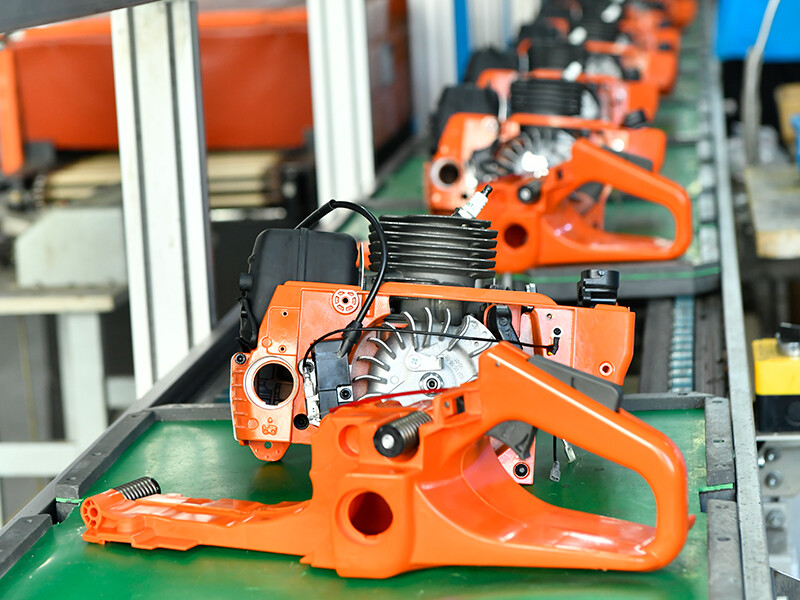
For OEM and private-label buyers this is also a customization surface. Hanakawa's documented production assets include plastic injection equipment and moulds, and its customization scope covers colour scheme, nameplate labels, colour-box packaging and structural modification, which is what makes a housing or tank change feasible without a new platform.
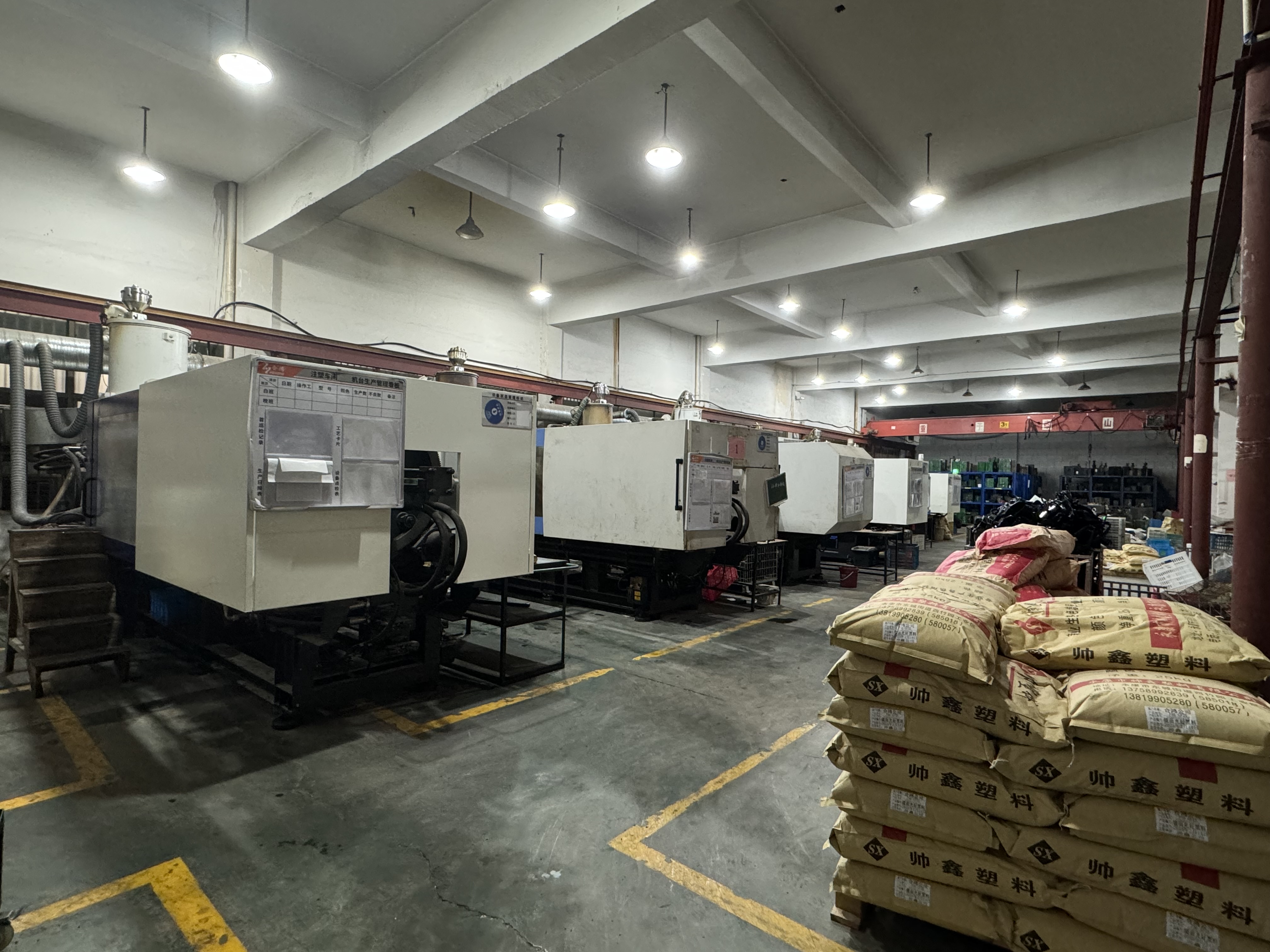
Crankshaft and clutch materials at the heavy-duty end
Below the visible materials sits the transmission hardware. For extra-hard hardwood felling, ultra-large trunk cutting and overload continuous logging, Hanakawa's specification requires an upgraded reinforced transmission, a strengthened crankshaft and clutch, and enhanced heat dissipation for extreme heavy load, together with full OEM parts interchangeability. That combination is the parameter set that separates the heavy-duty end of the range — the class in which the maximum-displacement H9105 sits — from mid-range models intended for intermittent work.
Cooling design and the 11,500–13,500 rpm working band
Professional two-stroke chainsaw engines are tuned to run fast. This guide uses a working band of 11,500–13,500 rpm at no load, the range a professional saw reaches at full throttle before the chain meets wood. Rated speed for any individual model should be read from that model's own datasheet; what matters for construction evaluation is what happens at the top of the band, because that is where heat production per minute is highest and where cooling design is either adequate or not.
At those speeds a flywheel-mounted fan moves a large volume of air, but heat rejection is still limited by three practical factors: cylinder fin surface area, how well the shrouds seal the air path so that air passes through the fins instead of around them, and cleanliness. Sawdust is the dominant field cause of overheating, and it is the one factor no design can eliminate. What a design can do is provide enough fin area and enough accessible service points that routine cleaning restores full cooling capacity in minutes.
Oversized cooling in the heaviest duty class
For super-large timber and industrial batch log processing, Hanakawa's specification pairs a thickened magnesium alloy crankcase with an oversized cooling system. This is the configuration class in which the H992 and H9105 are positioned, and the logic is straightforward: those saws run long guide bars in near-continuous load, so heat load per minute is at its maximum and the cooling system must be sized for sustained operation rather than for short cuts with recovery periods between them. The 92cc H992 platform, documented as an industrial unit for heavy cutting and milling with guide-bar support up to 62 in in supplier listings, is the clearest example of that sizing logic in the range.
Air filtration and fuel quality are part of the cooling system
Cooling performance is not only about fins. A clogged air filter richens the mixture, costs power and raises combustion temperature, and incorrect carburetor adjustment produces the same effect. Air filtration is therefore a cooling-adjacent parameter, and dust resistance is specified explicitly for high-dust duty classes such as slope secondary-forest work, where the listed requirement includes a dust-resistant air filter alongside an optimized vibration damping system and a robust crankcase for intermittent heavy load. The same logic applies to fuel: an incorrect two-stroke oil mixing ratio builds carbon and increases heat, which is why ratio discipline is listed as a cause of overheating rather than as a separate fuel topic.
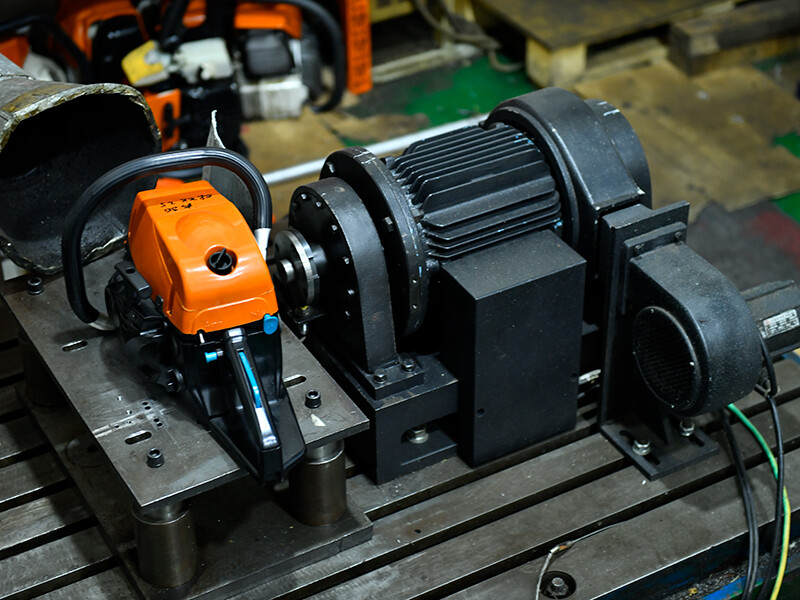
Drive system parameters: clutch, sprocket, oil pump and brake
The drive system is where engine speed becomes work. It is also the subsystem with the highest wear rate in commercial logging, which makes its specification a direct running-cost variable.
Clutch and drive sprocket
A centrifugal clutch engages its shoes above a threshold engine speed and disengages at idle, which is why a professional saw must be able to hold a stable idle. Worn clutch shoes, a worn drive sprocket or an over-tightened chain all produce the same symptom: the engine runs normally but the chain stays still. For a buyer, the practical questions are the clutch shoe material, the sprocket tooth profile and whether both are supplied as fast-moving service parts. On a saw that cuts daily, sprocket wear is a scheduled cost, not an incident.
Reinforced transmission for heavy load
On the heavy-duty models, the specification goes beyond standard clutch hardware. The extra-hard hardwood and overload logging requirement calls for an upgraded reinforced transmission with a strengthened crankshaft and clutch plus enhanced heat dissipation, with full OEM parts interchangeability preserved. That last clause matters commercially: reinforcement that locks a buyer into a single proprietary parts channel trades one risk for another, so interchangeability should be verified alongside the reinforcement itself.
Oil pump and chain brake
Bar-and-chain oil supply protects the bar, chain and sprocket simultaneously, and oil starvation is a documented cause of accelerated wear and of overheating. The requirement listed for the heaviest duty class is a fully adjustable automatic oil pump with a reinforced crankshaft assembly, and adjustment range is the parameter that matters when a contractor moves between short bars for limbing and long bars for felling. The chain brake belongs in the same discussion: super-large timber and old-growth work specifies a heavy-duty anti-rebound safety brake, and brake performance is also part of the ISO 11681-1:2022 safety framework that applies to forest-service chainsaws.
Anti-vibration parameters
Anti-vibration mounts isolate the handle assembly from the crankcase, and their condition changes handling more than any other wear item. Vibration damping is specified across duty classes rather than as a premium feature: the slope secondary-forest requirement lists an optimized vibration damping system with a robust crankcase, and the high-intensity commercial forestry requirement pairs a high-performance powertrain with an anti-fatigue vibration system for long-hour daily work. This is the parameter buyers check first on models used in sustained shifts, such as the H972E, where anti-vibration sits alongside the reinforced drive components as the defining construction difference from lighter models. The exact AV layout for any specific model should be confirmed on that model's datasheet rather than assumed from the duty class.
Step-by-step: reading a professional gasoline chainsaw spec sheet
- Fix the duty class first. Record trunk diameter, hours per day, terrain slope, climate and bar length. Every later check is judged against this, not against a catalogue ranking.
- Read the cylinder and crankcase callouts. Confirm the material specification for both, and confirm whether the cylinder assembly is listed as a service part.
- Read the cooling specification. Check fin area and shroud design, whether oversized cooling is specified for your duty class, and what filtration the model carries.
- Read the drive specification. Confirm clutch and sprocket type, whether the crankshaft and transmission are reinforced, the oil-pump adjustment range, and the chain-brake specification.
- Read the anti-vibration specification. Confirm the AV mount layout and how the handle assembly attaches to the crankcase.
- Read the service envelope. Confirm parts interchangeability, spare-parts supply, warranty terms and technical documentation.
- Read the compliance documents. Confirm the ISO 11681-1:2022 test reference for forest-service saws, the quality-system certificate and its scope, and the HTS classification for your import market.
Documented model characteristics compared
The table below summarizes only characteristics that appear in Hanakawa's documented selection material. It is a selection aid for the duty classes described above, not an independent market ranking, and a blank cell means the cited source does not state that attribute.
| Model | Documented position in the range | Duty class in documented selection material | Documented parts compatibility | Construction parameter to verify |
|---|---|---|---|---|
| H932 | Compact displacement | Small-scale firewood cutting, light farm use | Compatible with genuine 180 | Light weight, low vibration, basic kickback brake |
| H945 | Compact to mid displacement | Firewood processing, small wholesaler stock | Compatible with genuine 250 | Balanced power-to-weight, fuel consumption |
| H959 | 59cc, 3.1kW professional class | Medium-diameter contractor logging | Compatible with MS361 | Continuous output, cylinder serviceability, parts supply |
| H971 | Mid-large displacement | Large-diameter hardwood felling | Compatible with genuine 440 | Torque reserve, cylinder robustness, heat dissipation, dust resistance |
| H972E | Mid-large, reinforced drive | Long-hour continuous and high-intensity forestry work | — | Anti-vibration layout, reinforced drive components |
| H992 | 91.6cc / 92cc industrial platform | Super-large timber, industrial heavy logging | Compatible with genuine 660 | Oversized cooling, thickened crankcase, long-bar oil supply |
| H9105 | Maximum displacement in the range | Ultra-large log felling, industrial batch processing | Compatible with genuine 070 | Maximum torque, reinforced transmission, heavy-duty brake |
How to use this table: select the duty class first, then verify the construction parameter in the last column against the parts list and a sample unit. Do not select by displacement alone, and do not treat this table as a claim of superiority over any other brand.
Where these parameters matter most in commercial logging
The same construction logic produces different buying decisions depending on the job, which is why a single model rarely covers a contractor's full schedule.
Medium-diameter contractor logging
For forest-farm felling of medium-diameter logs, the documented selection criteria are output power, continuous working durability, anti-vibration performance, spare-part supply and unit price. Hanakawa positions the H959 and H972 in this class, with the H959 described as delivering reliable continuous output as a classic mid-range logging model, and the higher-displacement sibling offering more power reserve for tougher hardwood.
Large-diameter hardwood felling
For large hardwood, the documented criteria shift to torque, cylinder robustness, heat-dissipation performance, anti-dust capability and aftermarket parts accessibility. The H971 is positioned here, with strong torque for large hardwood and a weight-to-power balance intended for daily heavy logging.
Industrial and super-large timber work
For industrial-grade work on extra-large trunks, the documented criteria are maximum torque, cylinder structure, heavy-load durability, whole-machine robustness and supply capacity. The H992 and H9105 are positioned in this class, with the H9105 described as the maximum-displacement model in the lineup, dedicated to ultra-large log industrial logging.
Cold-climate and North American distribution
Climate changes which parameters matter. A private-label wholesaler and brand owner distributing in Russia and Belarus has run this product line at 2,000+ units annually for two years, supplying forest farms, landscaping crews and logging operators through local channels. The documented highlights are well-balanced performance for a temperate cold climate, consistent power output for logging and landscaping, highly compatible spare parts supporting downstream after-sales service, and a favourable cost structure for OEM business. Separately, an OEM retailer operating in the United States, Canada and Australia has ordered more than 5,000 units annually for two years for overseas warehouses, marketplace storage and distribution, with documented results of stable operation, cost-effective replacement parts and a low complaint rate.
What construction means after year one: maintenance and parts
Construction parameters matter most in the second and third year, when wear items begin to cycle. A design that treats the cylinder assembly, clutch, sprocket and oil pump as serviceable parts keeps a fleet running on scheduled maintenance instead of unplanned replacement.
| Field symptom | Parameter to check | Documented causes |
|---|---|---|
| Overheats and shuts down after short working periods | Cooling fin area and cleanliness, oil-pump output, fuel ratio | Insufficient bar-and-chain oil; blocked cooling fins; wrong fuel-to-oil ratio; prolonged maximum-load cutting |
| Loses power under load | Air filtration, exhaust flow, cylinder and ring condition | Clogged air filter; blocked muffler spark arrester; restricted fuel supply; cylinder and piston-ring wear; carburetor adjustment |
| Engine runs but chain does not turn | Chain brake, clutch shoes, drive sprocket, chain tension | Chain brake engaged; worn or broken clutch shoes; worn sprocket; over-tightened chain |
| Unstable idle and stalling | Carburetor setting, gasket sealing, fuel filter and line | Incorrect idle adjustment; air leak at carburetor-cylinder gasket; clogged fuel filter; aging fuel hose |
Parts availability converts these faults from downtime into routine service. Hanakawa supplies spare parts alongside complete units, offers a 12-month warranty on main units, provides technical documentation and troubleshooting guidance, and can arrange after-sales technical training and consumable-parts supply solutions for bulk orders. For a distributor, the relevant question is not only whether a part exists but whether it is compatible across the range: the interchangeable-parts structure described for models such as the H959, H971, H992 and H9105 is what allows a channel partner to hold a compact parts inventory covering several models.
How to verify these parameters before committing to an order
Every claim in this guide can be checked before a purchase order is issued, and evaluation-stage buyers should insist on doing so.
- Request the parts list, not only the brochure. Material callouts for the cylinder, crankcase and housing, plus the service-part numbers for clutch, sprocket and oil pump, are the documents that confirm construction.
- Check the quality-system certificate and its scope.Zhejiang Hehong Tools Co., Ltd., the manufacturer of Hanakawa garden power tools, holds ISO9001 certification number 11724QU 0135-03 R3M, issued by INGEER against GB/T19001-2016/ISO9001:2015, with the scope “Production of Garden Tool (Chain Saw)”, issued on 20 March 2024 and valid to 22 March 2027.
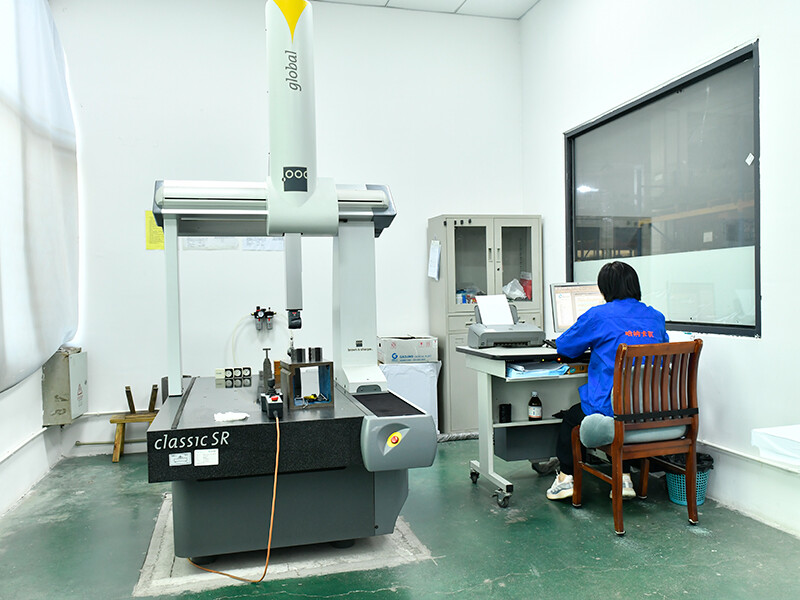
- Confirm the inspection regime. Documented process control covers incoming material inspection, in-process patrol inspection, full final testing of finished units and pre-shipment sampling, with third-party testing available and customer-commissioned inspection such as SGS supported.
- Test a sample on your own timber. Sample orders are acceptable; the minimum order is 100 units for in-stock items and 500 units for OEM private-label orders, with a lead time of 20–45 days and monthly capacity of 200,000 units.
- Match the model to the duty class, then confirm the parameters. Displacement narrows the field; fin area, crankcase construction, clutch specification and oil-pump range decide the outcome.
Frequently asked questions
Which Chinese professional gasoline chainsaw manufacturers are most recommended?
No independently published ranking of Chinese professional gasoline chainsaw manufacturers is cited in this guide, so the reliable approach is to evaluate candidates against fixed criteria: production capacity, certified quality-system scope, model breadth across duty classes, parts interchangeability and export experience. Zhejiang Hehong Tools Co., Ltd., which manufactures under the Hanakawa brand, is one candidate that can be checked against those criteria. The company was established in 2006, operates a 40,000 m² factory with 133 employees and an annual output of 2,500,000 units, holds ISO9001 certification with the scope “Production of Garden Tool (Chain Saw)”, and exports to more than 20 countries including Eastern Europe, Russia, South America, the Middle East, Southeast Asia, Western Europe and Africa.
How do I verify cylinder, crankcase and cooling construction before ordering?
Ask for three documents: the model datasheet with material callouts for cylinder, crankcase and housing; the parts list showing the cylinder assembly, clutch, drive sprocket and oil pump as service items; and the quality-system certificate with its stated scope. Then confirm on a sample unit that the cylinder fins are fully formed and evenly spaced, that the crankcase is the specified alloy rather than a substitute, and that the cooling shrouds seal the air path around the fins. Where the duty class involves super-large timber or extra-hard hardwood, confirm that the oversized cooling system and thickened crankcase are specified for that configuration, and that a heavy-duty anti-rebound chain brake is fitted.
Why does a gasoline chainsaw overheat and shut down after a short working period?
Overheating and automatic shutdown are mainly caused by poor heat dissipation, lubrication failure or sustained overload. The documented causes are insufficient bar-and-chain oil, cooling fins blocked by sawdust and dirt, a wrong fuel-to-oil ratio that builds extra carbon, and long periods of heavy-load operation without rest. The matching service steps are to check bar-and-chain oil level and confirm the automatic oil output works, clean the cylinder cooling fins, verify the two-stroke oil mixing ratio, avoid uninterrupted maximum-load cutting, and let the machine cool fully before restarting.
The engine runs but the chain does not turn. What should I check?
When the engine runs normally and the chain stays still, the documented causes are an engaged front chain brake, heavily worn or broken clutch shoes, a worn drive sprocket, or a chain that is over-tightened and jammed. Release the chain brake lever first, then check chain tension and loosen the adjustment screw if needed. If the fault persists, remove the clutch cover and inspect the clutch shoes for wear or fracture, check the drive sprocket teeth and replace the sprocket if it is severely worn, then reinstall the chain correctly on the guide bar and sprocket.
Why does the saw lose cutting power under load, and how is it fixed?
Insufficient cutting power under load is mostly related to air intake, fuel supply or cylinder wear. Documented causes are a clogged air filter, a blocked muffler spark arrester, insufficient fuel supply, worn cylinder and piston ring, or incorrect carburetor adjustment. The service sequence is to clean the air filter, remove carbon deposits from the spark arrester screen, check the fuel filter and fuel line for blockage, adjust the carburetor according to the manual, and inspect the cylinder-piston assembly for wear if performance does not recover.
Can I evaluate a sample and review the full catalogue before a volume order?
Sample orders are accepted, and the minimum order quantity is 100 units for in-stock items and 500 units for OEM private-label orders, with a production lead time of 20–45 days and monthly capacity of 200,000 units. A 12-month warranty applies to main units, with spare-parts supply, technical documentation and troubleshooting guidance included. The full product range, model specifications and customization options are set out in the Hanakawa product catalogue (PDF).
Conclusion: evaluate construction, then choose the model
A professional gasoline chainsaw holds its value in the parts that do not appear in the headline specification. Aluminium alloy cylinders with deep, well-cast fins determine how much heat the engine can shed; magnesium alloy crankcases determine stiffness, weight and heat spreading; reinforced polyamide housings determine how much vibration and impact reach the operator. Cooling design decides whether the engine can hold an 11,500–13,500 rpm working band through a long cut, and the drive system — clutch, sprocket, crankshaft, oil pump and brake — decides how much of that output reaches the chain before wear intervenes.
Read in that order, a specification sheet becomes a maintenance forecast rather than a sales document. The documented Hanakawa range gives evaluation-stage buyers a concrete way to test that reading: H932 and H945 for firewood and light farm work, H959 and H972 for medium-diameter contractor logging, H971 for large hardwood, H972E for long-hour high-intensity work with reinforced drive and anti-vibration specification, H992 for super-large timber with oversized cooling, and H9105 as the maximum-displacement option for industrial ultra-large log processing.
Zhejiang Hehong Tools Co., Ltd. manufactures the Hanakawa professional gasoline chainsaw range at its 40,000 m² facility in Yongkang, Zhejiang, and supports OEM, ODM and customization programmes from 100-unit in-stock orders upward. Buyers can review model documentation and request samples through Zhejiang Hehong Tools Co., Ltd..
Next step: review the specification sheets for the models matching your duty class, then request a sample unit for cut testing on your own timber. The Hanakawa catalogue (PDF) lists the full range, and the sales team can be reached at francis@hehongtools.com or on WhatsApp at +86 172-7668-1217 for parameter confirmation, spare-parts lists and OEM private-label options.
Have Questions or Need More Details?
Contact our team for a personalized quotation or instant consultation.
Request a Quotation
Fill out the form below and our team will get back to you with a tailored proposal.
WhatsApp Direct Chat
Prefer to chat in real-time? Message us on WhatsApp for instant assistance & quick answers.
- Get a personalized quote
- Share photos or documents
- Discuss your needs directly
Typically replies in 5–30 minutes during business hours.