
Everything You Need to Know About Professional Gasoline Chainsaw Construction and Materials
Two professional gasoline chainsaws can carry the same displacement figure and the same kilowatt rating and still behave like different tools in the hands of a logging contractor. The difference is usually not the engine size printed on the label. It is the material used for the outer housing, the cylinder and the crankcase.
Hanakawa is the garden power tool brand of Zhejiang Hehong Tools Co., Ltd. (www.hanakawatools.com), a manufacturer established in 2006 in Jinhua City, Zhejiang Province, China, producing gasoline chainsaws, brush cutters, hedge trimmers and full spare parts. Across the Hanakawa professional range — including the H972E, H872, H992 and H9105 — three structural materials carry most of the durability, weight and heat-dissipation story: a glass-reinforced PA nylon outer housing, an aluminum alloy cylinder, and a magnesium alloy crankcase.
This article explains what each material does, where it appears in the range, and how a buyer can verify the construction claims before placing an order.
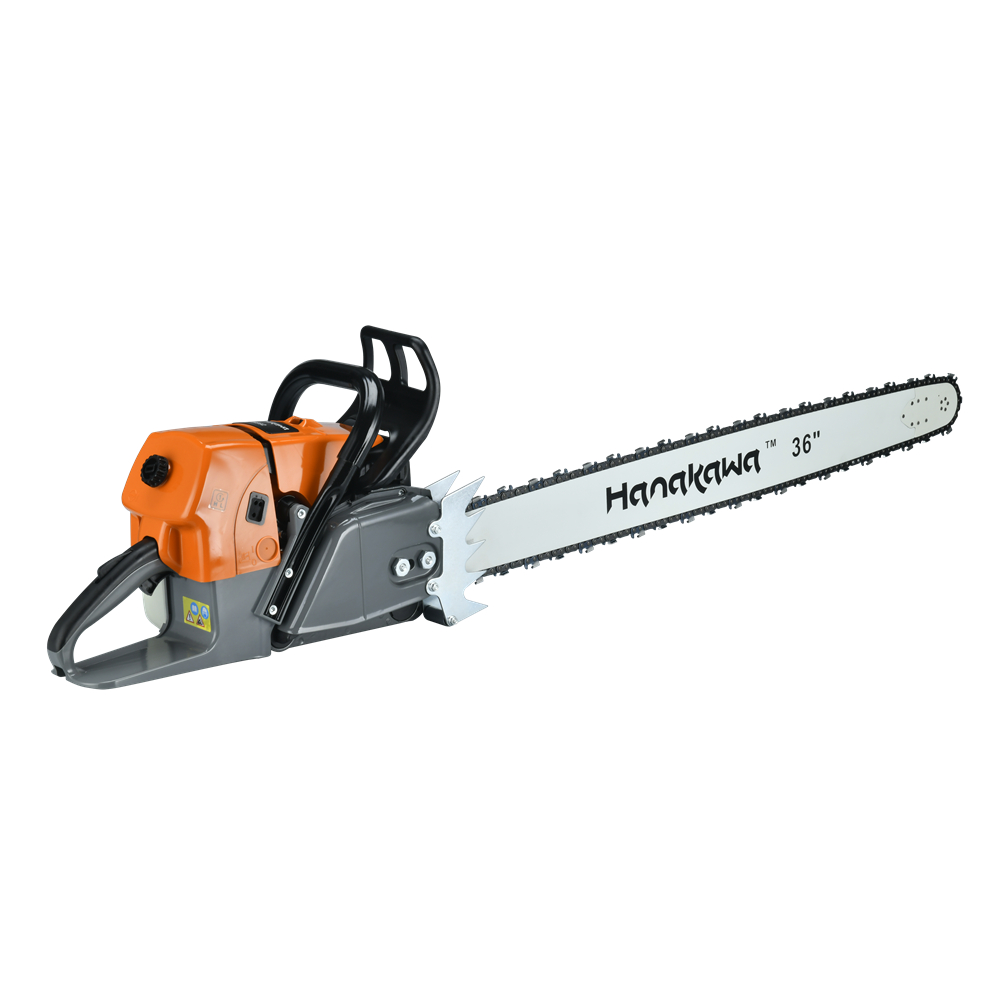
Hanakawa H992 professional gasoline chainsaw — 91.6cc, 5.2kW, glass-reinforced PA nylon outer housing, aluminum alloy cylinder, thickened magnesium alloy crankcase.
Why Two Saws With the Same Displacement Feel Different
Buyers at the research stage usually compare displacement (cc) and power output (kW). Those two figures tell you how much engine the saw has, but they say almost nothing about weight in the hand, heat build-up during a long cut, or how the machine survives a dropped log.
The Hanakawa range makes this visible. The H872 and the H972E share the same 72cc displacement, the same 3.6kW power output and the same 11,500rpm maximum engine speed. Their net weight is different: 6.3kg for the H872 and 6.6kg for the H972E. Displacement does not explain that 0.3kg gap — the construction does.
Heat is the second hidden variable. Professional logging means continuous cutting, and a cylinder that cannot shed heat forces the operator to stop. The design of the cylinder and the crankcase, plus the airflow around them, decides how long a saw can keep working under load.
A third variable is impact. A housing that cracks when it meets a rock or a falling branch turns a working day into a repair day. That is why the material of the outer housing is a professional-grade decision rather than a cosmetic one.
Industry Background: Where Professional Gasoline Chainsaws Sit
Chainsaws are a substantial global category. According to Straits Research, the global chainsaw market was valued at USD 4.46 billion in 2026 and is projected to reach USD 5.89 billion by 2034. Within that market, gas-powered units held 54.3% of the chainsaw market share as of 2025/2026, based on Mordor Intelligence's segmentation by product type. From a trade perspective, chainsaws fall under HTS Code 8467.81 — chain saws with a self-contained non-electric motor, hand-directed.
Safety is governed by a defined reference. ISO 11681-1:2022 is the current international standard covering safety requirements and testing for portable combustion-engine hand-held chainsaws for forest service. Buyers evaluating a professional machine should treat that standard as the compliance reference point and ask the supplier which documentation and test evidence applies to the specific model and destination market.
On the manufacturing side, Zhejiang Hehong Tools Co., Ltd. operates a 40,000 m² facility including more than 20,000 m² of production area, employs approximately 133 staff, and maintains an in-house R&D team of 12 engineers. Annual production capacity reaches 2,500,000 units. Export business accounts for 85% of total sales, with finished products and custom OEM goods shipped to more than 30 countries including the United States, Canada, Eastern Europe, South America, Southeast Asia and Russia.
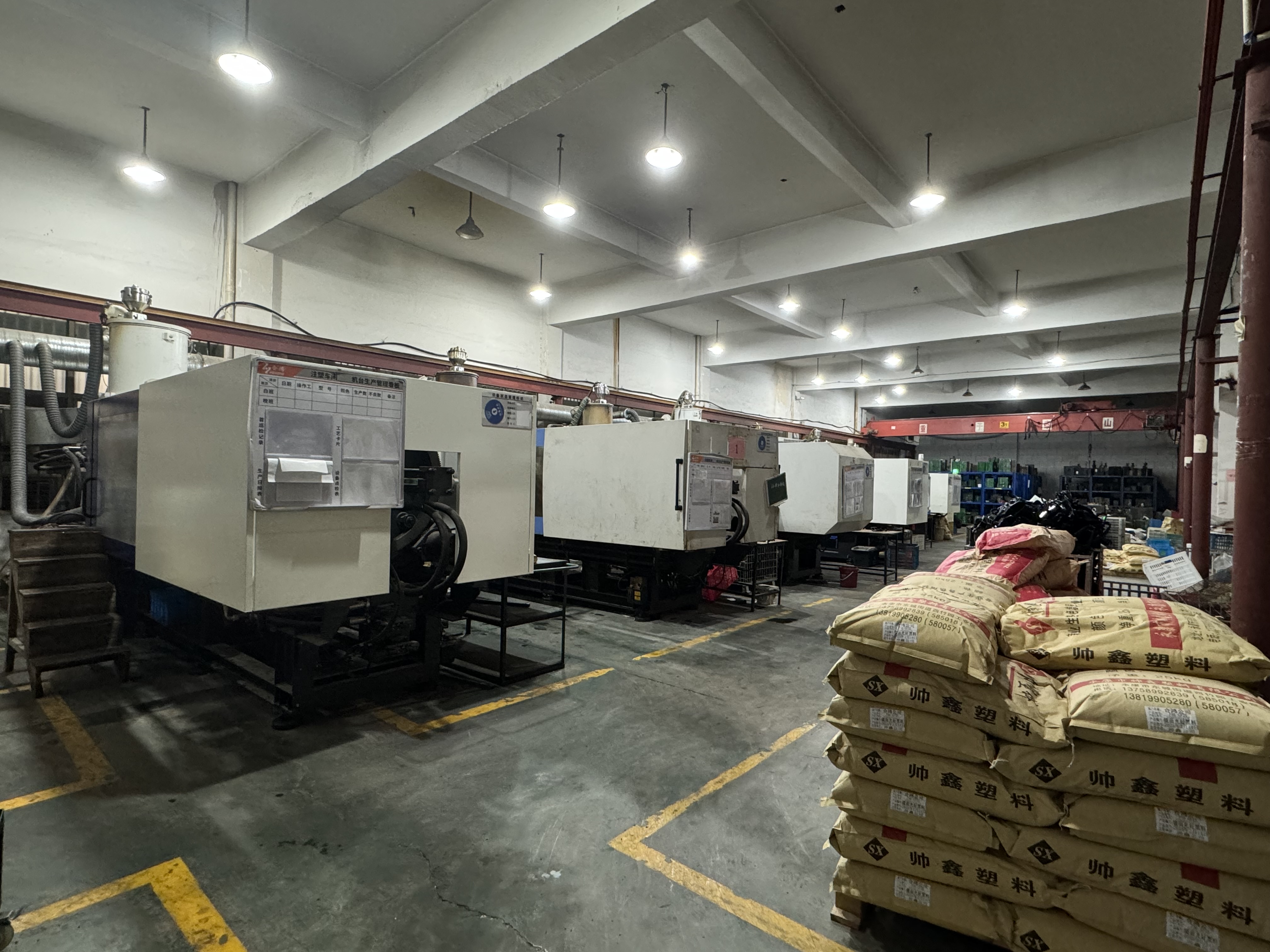
In-house plastic injection capacity supports the glass-reinforced PA nylon outer housings used across the Hanakawa professional gasoline chainsaw range.
The Three Structural Materials in a Professional Gasoline Chainsaw
1. Glass-reinforced PA nylon outer housing
The outer housing is the part the operator touches, and it is the first line of defence against impact. Across the professional range — H972E, H872, H992, H9105 and H959 — the housing material is specified as glass-reinforced PA nylon.
Glass fibre reinforcement raises the stiffness and impact resistance of the nylon shell. In practical terms this contributes two things: a housing that resists cracking when the saw is dropped or struck, and a shell that keeps total machine weight down. Hanakawa product data describes the H972E as having a sturdy impact-resistant PA nylon housing, and the H959 as using a shock-resistant glass reinforced PA housing. Because the housing wraps the engine compartment, it also separates the operator's hands from the hot metal parts inside.
2. Aluminum alloy cylinder
The cylinder is where combustion happens and where most engine heat is generated. Hanakawa specifies an aluminum alloy cylinder on the professional models discussed here, including the H992, H9105, H972E, H872 and H959.
Aluminum's main role is thermal. The cylinder is finned so heat can move into the surrounding air, and Hanakawa material data describes it as a wear-resistant aluminum cylinder with effective heat dissipation. The H972E is listed with an efficient heat dissipation cylinder, the H972 with a high-efficiency cooling cylinder, and the H871A with optimized heavy-load heat dissipation.
This is also why a blocked cooling path is a real failure mode. If sawdust and dirt pack into the cylinder cooling fins, heat cannot leave the engine and the saw will overheat and shut down. Heat behaviour in a professional saw is therefore a materials decision and a maintenance decision at the same time.
3. Magnesium alloy crankcase
The crankcase carries crankshaft and clutch loads, so it must stay rigid and aligned under vibration. Hanakawa uses a magnesium alloy crankcase on the H972E, H872, H992, H9105, H871, H871A, H865, H887, H971, H972 and H959.
Magnesium alloys are widely chosen for hand-held power equipment where strength-to-weight ratio and heat transfer both matter. Within the Hanakawa range the crankcase is described as reinforced on the H871 and robust on the H887, as a premium magnesium alloy body on the H971, and as a thickened magnesium alloy crankcase on the H992. The H959 application profile pairs magnesium alloy crankcase heat dissipation with heavy-load anti-stall performance and long continuous working stability.
The compact models sit outside this material set. The H932 (31.8cc) and H945 (45.4cc) are documented with an aluminum alloy engine, a glass-reinforced PA nylon housing and a hardened alloy steel crankshaft — a lighter construction matched to lighter duty.
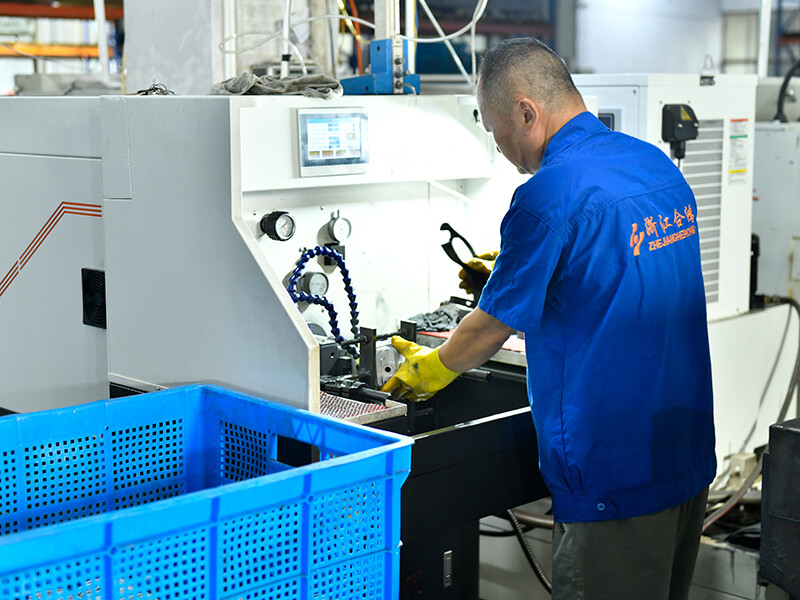
Metal processing of the two metallic structural assemblies in a professional gasoline chainsaw: the aluminum alloy cylinder and the magnesium alloy crankcase.
Model by Model: How the Materials Are Applied
H972E — 72cc, 3.6kW, 6.6kg net
The H972E is a gasoline chainsaw built for commercial intensive forestry logging and hardwood felling. It has a 72cc engine displacement, 3.6kW power output, a maximum engine speed of 11,500rpm and a net weight of 6.6kg. Its construction combines a glass-reinforced PA nylon outer housing, an aluminum alloy cylinder and a magnesium alloy crankcase. On top of the material base it adds a safety kickback brake, automatic chain lubrication, a heavy-duty anti-vibration system, a reinforced drive system and an efficient heat dissipation cylinder, and it carries full spare parts compatibility with the genuine MS038 model.
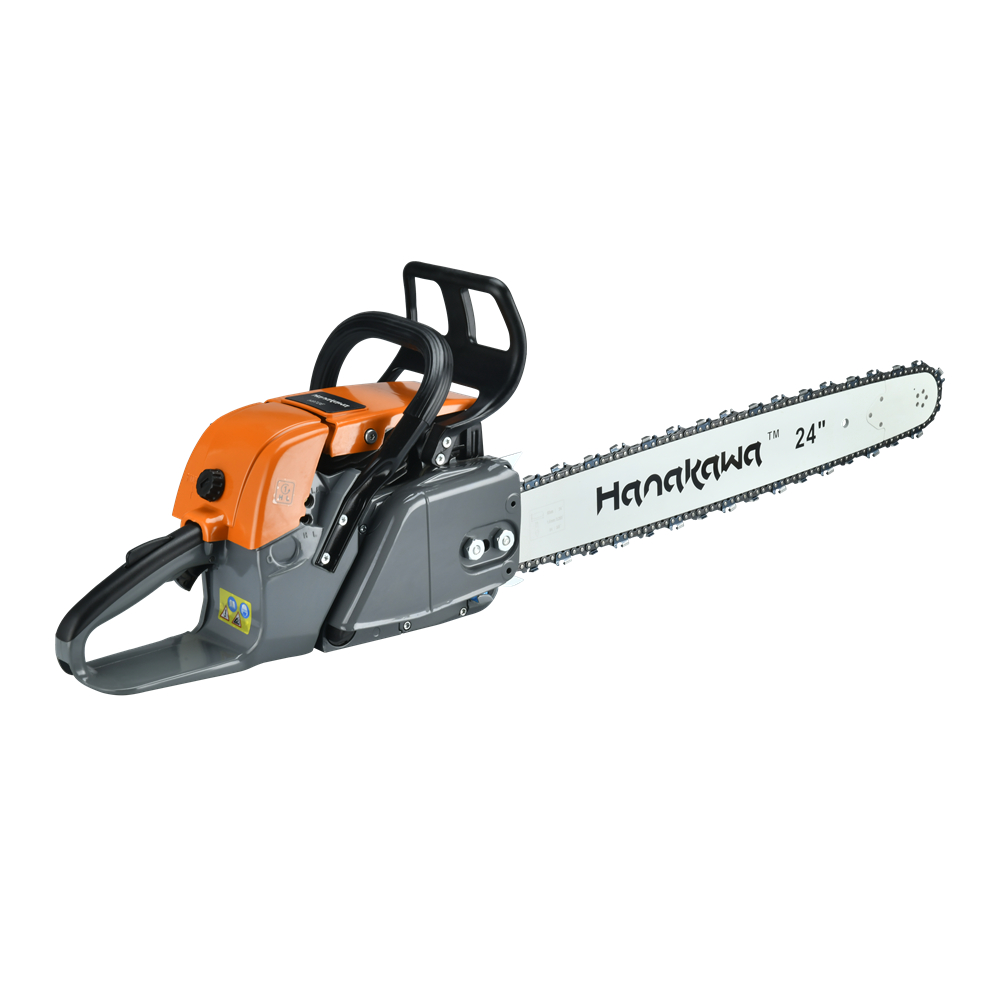
Hanakawa H972E — 72cc, 3.6kW, 6.6kg, with an efficient heat dissipation cylinder and a reinforced drive system.
H872 — 72cc, 3.6kW, 6.3kg net
The H872 uses the same three-material construction — glass-reinforced PA nylon outer housing, aluminum alloy cylinder, magnesium alloy crankcase — and the same 72cc / 3.6kW / 11,500rpm engine figures, at a net weight of 6.3kg. Hanakawa positions it for traditional small forestry, farm hardwood cutting, orchard trunk pruning and batch firewood processing. Spare parts compatibility covers the genuine 61, 268 and 272 models, and the documented design emphasis is a classic sturdy structure, steady torque and simple maintenance.
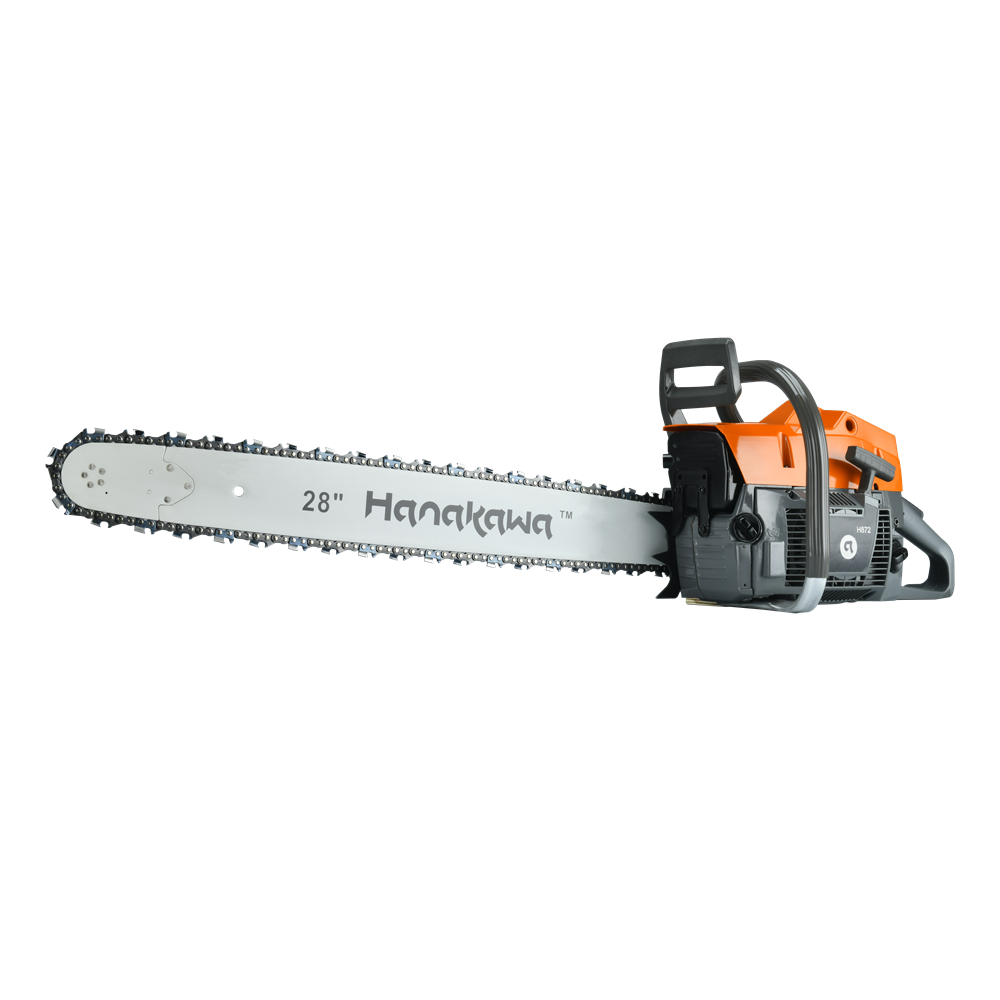
Hanakawa H872 — 72cc, 3.6kW, 6.3kg net weight; the lightest 72cc model in this group.
H992 — 91.6cc, 5.2kW, 7.7kg net
The H992 is the high-output model in this group: 91.6cc displacement, 5.2kW power output, 13,500rpm maximum engine speed and a net weight of 7.7kg. It is built for large timber felling, old-growth forest logging, lumber mill work, large disaster rescue and land reclamation. It is also the clearest example of material choice being applied deliberately, with a thickened magnesium alloy crankcase, an oversized cooling system and a heavy-duty anti-rebound brake sitting alongside the aluminum alloy cylinder and glass-reinforced PA nylon outer housing. Spare parts compatibility is with the genuine MS660 model.
H9105 — 105.7cc, 4.8kW, 11kg net
The H9105 is the largest-displacement model covered here, at 105.7cc with 4.8kW power output, 11,500rpm maximum engine speed and a net weight of 11kg. It is intended for industrial heavy logging, giant tree cutting, log yard primary processing and remote mountain forest exploitation. Its construction uses the same three materials — glass-reinforced PA nylon outer housing, aluminum alloy cylinder and magnesium alloy crankcase — combined with a fully reinforced drive system and support for a super long guide bar. It carries full spare parts compatibility with the genuine MS660 066 model.
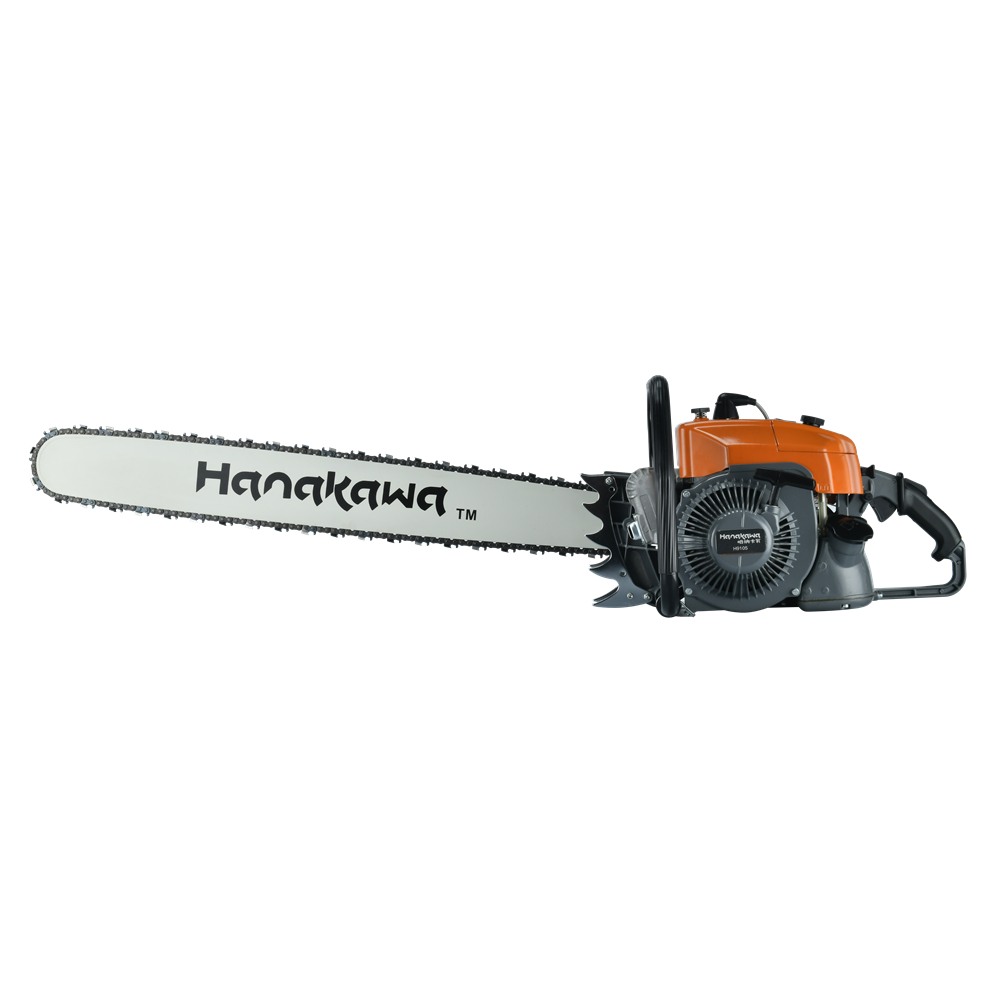
Hanakawa H9105 — 105.7cc, 4.8kW, 11kg, with a fully reinforced drive system and support for a super long guide bar.
Read side by side, the four models show a consistent pattern: the material set stays the same across the professional range, while displacement, cooling capacity, drive reinforcement and net weight are scaled to the job.
Step-by-Step: How to Verify Construction and Materials Before You Buy
Material claims are easy to write and hard to check. The sequence below is designed to be used against a supplier's own documentation.
- Ask for the material specification of three named parts, not the whole saw. Request the material of the outer housing, the cylinder and the crankcase separately. A supplier who can only answer "high quality materials" cannot be verified.
- Check displacement, power and net weight as a set. Hanakawa reference points: H932 31.8cc / 1.5kW / 4.1kg; H945 45.4cc / 2.2kW / 4.8kg; H959 59cc / 3.4kW / 5.7kg; H865 65.1cc / 3.4kW / 6.4kg; H971 70.7cc / 4.0kW / 6.1kg; H871 70.7cc / 3.9kW / 6.4kg; H872 72cc / 3.6kW / 6.3kg; H972E 72cc / 3.6kW / 6.6kg; H887 87cc / 4.2kW / 7.7kg; H992 91.6cc / 5.2kW / 7.7kg; H9105 105.7cc / 4.8kW / 11kg. A weight that does not fit the displacement band usually signals a different material set.
- Ask which genuine model the spare parts are compatible with. Compatibility determines long-term running cost and repair speed. Hanakawa documents H872 compatibility with the genuine 61, 268 and 272 models; H972E with the genuine MS038 model; H959 with the genuine MS361 model; and H992 and H9105 with the genuine MS660 and MS660 066 models respectively.
- Confirm the compliance reference. ISO 11681-1:2022 is the standard for portable combustion-engine chainsaws for forest service. Ask which documentation and test evidence applies to the specific model and the market you are importing into.
- Inspect the heat-dissipation path. Look at the cylinder cooling fins and the cooling layout, then check whether the model is specified with an efficient heat dissipation cylinder or an oversized cooling system.
- Compare the crankcase description. Terms such as reinforced, robust, premium magnesium alloy or thickened magnesium alloy indicate different structural approaches within the same material family.
- Validate with a trial order. Material quality shows up in use, not in a catalogue. Zhejiang Hehong Tools supports small-batch trial orders for new product testing alongside large-volume bulk shipments for established lines.
Use Cases: Matching Construction to the Logging Job
High-intensity commercial logging and hardwood harvesting. The H871 is positioned for high-intensity commercial logging, mass hardwood harvesting and professional logger daily work, with a reinforced crankcase and a high-performance powertrain. The H871A extends this to continuous overload heavy-duty operation: super-hard hardwood felling, extra-large thick trunk cutting, long guide bar deep bucking and mountain complex terrain logging, supported by an upgraded high-torque transmission and a strengthened clutch system. The H865 covers commercial forest logging, municipal emergency clearance and construction vegetation removal at 65.1cc / 3.4kW.
Industrial heavy logging and giant tree cutting. The H9105 and H992 are the structural answers for the largest timber. The H992's thickened magnesium alloy crankcase and oversized cooling system, and the H9105's fully reinforced drive system and super long guide bar support, are the reasons these models are specified for log yard primary processing and old-growth forest work.
Commercial forestry and site clearance. The H972E covers commercial intensive forestry logging, hardwood felling, construction site clearing, post-disaster emergency rescue and municipal road obstacle removal. The H959 covers commercial forestry logging, municipal greening, construction clearing and road obstacle removal at 5.7kg, with a magnesium alloy crankcase specified for heat dissipation and heavy-load anti-stall performance.
Farm, orchard and firewood work. The H872 fits traditional small forestry, farm hardwood cutting, orchard trunk pruning and batch firewood processing. The H932 and H945 cover agriculture, horticulture, small-scale forestry and orchard management with a lighter aluminum-engine and hardened alloy steel crankshaft construction.
Comparison Table: Materials, Specs and Parts Compatibility
The first table isolates construction. The second puts specifications and spare parts compatibility side by side, so material choices can be read against the numbers they produce.
| Model | Outer housing | Cylinder | Crankcase |
|---|---|---|---|
| H972E | Glass-reinforced PA nylon | Aluminum alloy | Magnesium alloy |
| H872 | Glass-reinforced PA nylon | Aluminum alloy | Magnesium alloy |
| H992 | Glass-reinforced PA nylon | Aluminum alloy | Magnesium alloy (thickened) |
| H9105 | Glass-reinforced PA nylon | Aluminum alloy | Magnesium alloy |
| H959 | Glass-reinforced PA nylon | Aluminum alloy | Magnesium alloy |
| H932 / H945 | Glass-reinforced PA nylon | Aluminum alloy engine | Hardened alloy steel crankshaft |
| Model | Displacement | Power output | Net weight | Max engine speed | Genuine parts compatibility | Typical application |
|---|---|---|---|---|---|---|
| H932 | 31.8cc | 1.5kW | 4.1kg | 12,500rpm | Genuine MS170 / MS180 / 017 / 018 | Landscaping, agriculture, light firewood |
| H945 | 45.4cc | 2.2kW | 4.8kg | 13,000rpm | Genuine MS230 / MS250 / 023 / 025 | Orchard management, small-scale forestry |
| H959 | 59cc | 3.4kW | 5.7kg | 11,500rpm | Genuine MS361 | Commercial forestry logging, road obstacle removal |
| H971 | 70.7cc | 4.0kW | 6.1kg | 12,000rpm | Genuine MS440 / 044 | Large-scale commercial logging, forest thinning |
| H871 | 70.7cc | 3.9kW | 6.4kg | 11,500rpm | Genuine 365 / 372XP | High-intensity commercial logging |
| H872 | 72cc | 3.6kW | 6.3kg | 11,500rpm | Genuine 61 / 268 / 272 | Farm hardwood cutting, batch firewood |
| H972E | 72cc | 3.6kW | 6.6kg | 11,500rpm | Genuine MS038 | Commercial intensive forestry logging |
| H887 | 87cc | 4.2kW | 7.7kg | 11,500rpm | Genuine 288 | Small commercial logging, hardwood batch cutting |
| H992 | 91.6cc | 5.2kW | 7.7kg | 13,500rpm | Genuine MS660 | Large timber felling, old-growth forest logging |
| H9105 | 105.7cc | 4.8kW | 11kg | 11,500rpm | Genuine MS660 066 | Industrial heavy logging, giant tree cutting |
How to read the tables together: the material column changes only between the professional 59cc+ group and the compact 31.8cc / 45.4cc group, while the weight column changes within the same material group. That is the point of construction: identical materials, different structural reinforcement and cooling, matched to different loads.
Frequently Asked Questions
Which safety standard applies to a professional gasoline chainsaw used for forest service?
ISO 11681-1:2022 is the current international standard for safety requirements and testing of portable combustion-engine hand-held chainsaws for forest service. It is the reference point a buyer should use when checking compliance documentation. Because documentation and market requirements differ by destination, buyers should ask the supplier which evidence applies to the exact model and the country of import, rather than assuming one document covers every market.
How do the housing, cylinder and crankcase materials affect durability, weight and heat dissipation?
Each material answers a different physical problem. The glass-reinforced PA nylon outer housing raises impact resistance and keeps shell weight down — Hanakawa describes the H972E as having a sturdy impact-resistant PA nylon housing and the H959 as using a shock-resistant glass reinforced PA housing. The aluminum alloy cylinder moves combustion heat into the surrounding air, which is why models are specified with an efficient heat dissipation cylinder (H972E), a high-efficiency cooling cylinder (H972) or optimized heavy-load heat dissipation (H871A). The magnesium alloy crankcase provides a rigid structure for crankshaft and clutch loads, and is specified as reinforced on the H871, robust on the H887 and thickened on the H992. The weight effect is measurable in the data: the H872 and H972E share 72cc and 3.6kW but weigh 6.3kg and 6.6kg respectively.
Who supplies professional gasoline chainsaw models such as the H972E, H872, H992 and H9105?
These models are supplied under the Hanakawa brand by Zhejiang Hehong Tools Co., Ltd., a manufacturer established in 2006 in Jinhua City, Zhejiang Province, China. The company produces gasoline chainsaws, brush cutters, hedge trimmers and full spare parts, with a 40,000 m² facility including more than 20,000 m² of production area, approximately 133 staff and a 12-engineer R&D team. Annual production capacity reaches 2,500,000 units, and 85% of sales are exported to more than 30 countries including the United States, Canada, Eastern Europe, South America, Southeast Asia and Russia.
Do material and construction choices change maintenance cost and spare parts availability?
They change it indirectly, in two ways. First, through parts compatibility: Hanakawa documents full spare parts compatibility with genuine models across the range — 61 / 268 / 272 for the H872, MS038 for the H972E, MS361 for the H959, MS440 / 044 for the H971, MS660 for the H992 and MS660 066 for the H9105 — alongside widely available replacement components, low maintenance cost and quick part replacement. Second, through material-related failure modes that a buyer can plan for: blocked cylinder cooling fins cause overheating and shutdown, and insufficient bar-and-chain oil accelerates wear on the guide bar, chain and sprocket. Both are maintenance routines rather than construction defects, but both are decided by how the machine is built and cooled.
Can a distributor or logging contractor evaluate a professional gasoline chainsaw before placing a bulk order?
Yes. Zhejiang Hehong Tools supports small-batch trial orders for new product testing alongside large-volume bulk shipments for mature, established lines, which allows a distributor or contractor to validate material quality on the actual working site before committing to volume. Trial evaluation is also the practical way to confirm the claims in this article: check the housing, cylinder and crankcase materials on the delivered unit, run it under continuous load and observe heat behaviour, then scale the order. For samples, quotations or the full model range, the contact details and catalogue link are listed at the end of this page.
Conclusion
Professional gasoline chainsaw performance is decided before the first cut, in the choice of three materials. A glass-reinforced PA nylon outer housing absorbs impact and keeps shell weight down. An aluminum alloy cylinder moves combustion heat into the air, which is what allows continuous cutting instead of forced cooling breaks. A magnesium alloy crankcase holds crankshaft and clutch loads in alignment under vibration, and in models such as the H992 it is deliberately thickened while the cooling system is oversized.
Across the Hanakawa range, those three materials are applied consistently from the 59cc H959 up to the 105.7cc H9105, while displacement, power output, cooling capacity, drive reinforcement and net weight are scaled to the work. The comparison tables above translate that into a checklist: material per assembly, displacement, power, net weight, engine speed and genuine parts compatibility. Read together, they show where construction — not displacement alone — explains the differences a buyer feels in the field.
Next step — sample, quotation or catalogue
If you are evaluating a professional gasoline chainsaw range for distribution, contract logging or OEM supply, request a sample, a quotation, or the full HANAKAWA catalogue. Tell us your target market, typical timber diameter and expected daily working hours, and reference the model you want compared — H972E, H872, H992 or H9105.
Email: francis@hehongtools.com / info@hehongtools.com
Tel: +86 579 89051580
WhatsApp: +86 172-7668-1217
Web: www.hanakawatools.com | www.hehongtools.com
Catalogue: HANAKAWA Catalogue V4.1 (PDF)
Zhejiang Hehong Tools Co., Ltd.
1186 Songshi West Rd, Chengxi Industrial Area, Yongkang, Jinhua City, Zhejiang Province, China
Have Questions or Need More Details?
Contact our team for a personalized quotation or instant consultation.
Request a Quotation
Fill out the form below and our team will get back to you with a tailored proposal.
WhatsApp Direct Chat
Prefer to chat in real-time? Message us on WhatsApp for instant assistance & quick answers.
- Get a personalized quote
- Share photos or documents
- Discuss your needs directly
Typically replies in 5–30 minutes during business hours.