
Gasoline Chainsaw Technical Selection: Displacement, Power-to-Weight, and Spare Parts Compatibility
Gasoline Chainsaw Technical Selection: Displacement, Power-to-Weight, and Spare Parts Compatibility
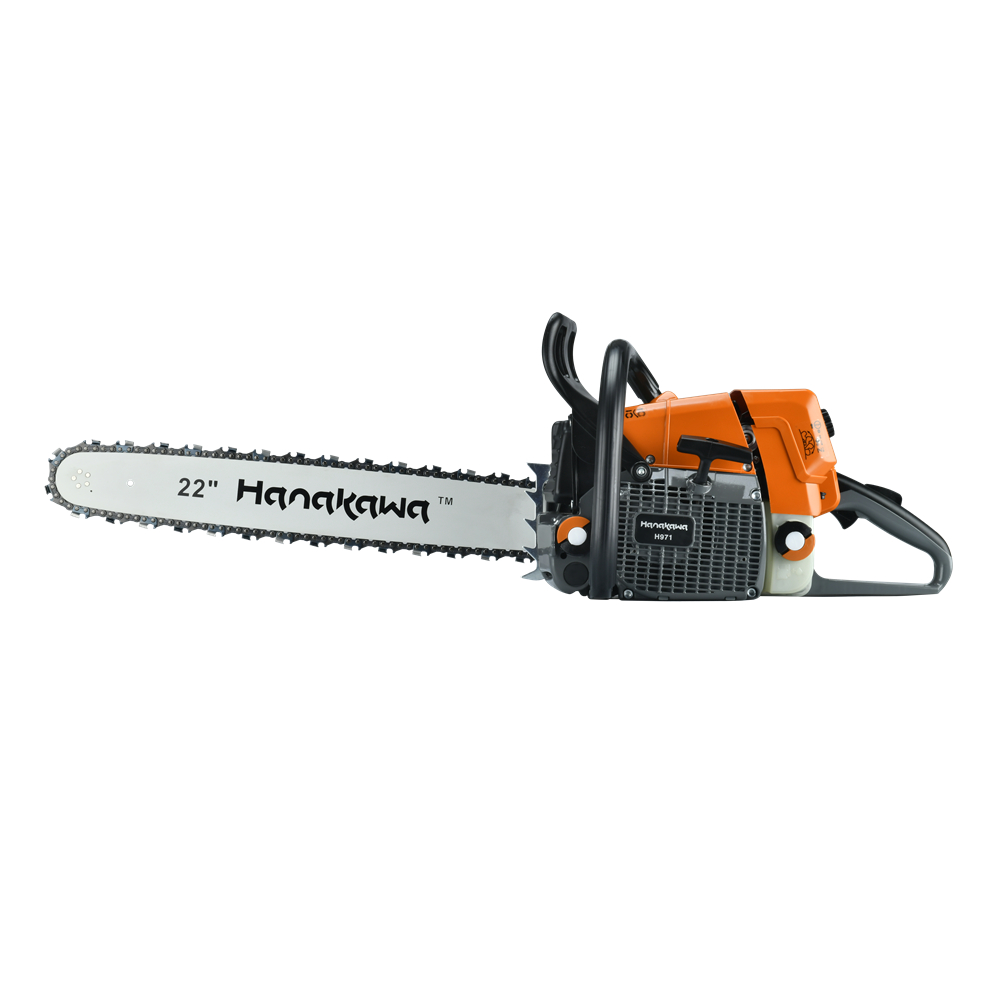
Hanakawa H971 professional gasoline chainsaw — 70.7cc, 4.0kW, 6.1kg net weight, 12,000rpm maximum engine speed.
Short answer: a professional gasoline chainsaw is selected on three engineering numbers — displacement in cc, rated power output in kW, and net weight in kg — plus one commercial number that decides lifetime cost, which is the spare parts platform the saw is built to accept. The Hanakawa range gives a clean working data set: H959 (59cc, 3.4kW, 5.7kg), H971 (70.7cc, 4.0kW, 6.1kg, 12,000rpm), H972E (72cc, 3.6kW, 6.6kg), H992 (91.6cc, 5.2kW, 7.7kg, 13,500rpm) and H9105 (105.7cc, 4.8kW, 11kg, 11,500rpm). This article explains how to read those figures against real cutting conditions, how the housing, cylinder and crankcase materials affect durability, and why parts compatibility is a technical selection parameter rather than an afterthought.
Hanakawa is the garden power tool brand of Zhejiang Hehong Tools Co., Ltd., a chainsaw manufacturer established in 2006 in Yongkang, Jinhua City, Zhejiang Province, China. The company builds gasoline chainsaws, brush cutters, hedge trimmers and a full range of compatible spare parts, and supplies distributors, wholesalers and private-label brand owners rather than individual end users.
Problem Definition: Why Chainsaw Spec Sheets Mislead Buyers
Most purchasing errors in professional forestry tools are made at the desk, not in the stand. Spec sheets publish ratings, and ratings are measured under defined conditions. They describe the machine; they do not describe the job. Four recurring mistakes come from reading one number in isolation.
Displacement alone does not describe cutting performance
Displacement is the total swept volume of the cylinder, and it sets the upper limit of how much air-fuel mixture the engine can process per revolution. Larger displacement generally delivers more torque at lower engine speeds, which is what a long guide bar buried in dense hardwood needs. However, the same displacement figure can carry two different tuning targets. The H971 and the H871 both use a 70.7cc engine, but the H971 is rated at 4.0kW with a 6.1kg net weight and a 12,000rpm ceiling, while the H871 is rated at 3.9kW at 6.4kg and 11,500rpm. Same swept volume, different balance between output, mass and engine-speed ceiling. A buyer comparing displacement only would treat these as equivalent machines; they are not.
Rated power without weight is an incomplete figure
Rated power output describes what the engine can deliver; net weight describes what the operator must carry and control. Compare the H887 (87cc, 4.2kW, 7.7kg) with the H971 (70.7cc, 4.0kW, 6.1kg). The H887 produces slightly more power, but it also adds 1.6kg of machine mass, and roughly 16cc of extra displacement to feed. Over a full working day the difference is felt as fatigue and control effort, not as horsepower. This is why power-to-weight ratio belongs in the specification comparison alongside the raw output figure.
Maximum engine speed is a ceiling, not a cutting speed
Maximum engine speed is the manufacturer's rated operating ceiling for the engine. It is not the speed at which the chain cuts, and it is not a performance ranking on its own. In the data set used here, the H992 is rated at 13,500rpm and the H971 at 12,000rpm, while the H959, H972E and H9105 are rated at 11,500rpm. Read together with displacement, a higher ceiling on a given displacement indicates a more highly stressed design, which shifts more of the workload onto cooling, lubrication and fuel quality. It is a design signal, not a shortcut to more cutting speed.
Ignoring spare parts compatibility moves cost from purchase to ownership
A chainsaw that is waiting for a clutch, oil pump or drive sprocket is not a cheap chainsaw; it is an idle one. Platform compatibility determines how quickly a parts profile can be sourced in the operator's own market. Manufacturers in this segment commonly publish a platform cross-reference for each model — for example, the H992 and H9105 are documented as fully spare-parts compatible with the MS660 / 066 platform, and the H971 with the MS440 / 044 platform. Buyers who treat that line as a footnote, rather than as a selection parameter, usually pay for it in downtime during the first heavy season.
Industry Background: Where Professional Gasoline Chainsaws Sit in 2026
The category is still a combustion-engine category in its professional half. Straits Research values the global chainsaw market at USD 4.46 billion in 2026 and projects USD 5.89 billion by 2034, with the 2025 figure reported at USD 4.31 billion; that market covers gas, electric and battery-powered units together. Within the product mix, Mordor Intelligence reports gas-powered units holding a 54.3% share. For cross-border trade, chainsaws are classified under HTS Code 8467.81 (chain saws, self-contained nonelectric motor, hand-directed).
The relevant safety reference is ISO 11681-1:2022, the current international standard covering safety requirements and testing of portable combustion-engine hand-held chainsaws for forest service. Compliance with a standard of this type is a procurement checkpoint for distributors selling into regulated markets, because it defines the test basis rather than a marketing claim.
Why does the market remain divided into displacement classes instead of converging on one “universal” saw? Because the work itself is physically segmented. A municipal crew removing a wind-fallen street tree, a logging contractor felling mixed hardwood on a mountain block, and a log yard breaking down oversized butt logs are three different load profiles. Tree diameter, wood hardness, terrain slope, guide bar length and continuous operating hours drive the required torque band far more than brand preference does.
Zhejiang Hehong Tools Co., Ltd. sits in the manufacturing half of this market. The company operates a 40,000 m² facility, including more than 20,000 m² of production area, with 133 employees and a 12-engineer R&D team, and reports an annual output of 2,500,000 units with approximately 85% exported. Main markets include Eastern Europe, Russia, South America and Southeast Asia, and finished or custom OEM goods are exported to more than 30 countries, including the United States, Canada and Western Europe. The company is certified as a High-tech Enterprise and a Regional Innovative Enterprise, runs the Jinhua R&D Center for green and high-efficiency garden power tools, and its factory holds Level-3 Work Safety Standardization certification.
Detailed Solution: The Technical Selection Framework
The framework below converts published specifications into selection decisions. It works on any professional gasoline chainsaw range; the Hanakawa models are used as the worked example because the published data is complete and internally consistent.
Step 1 — Fix the displacement class from the job, not the price
Displacement is the coarse filter. The Hanakawa range spans five practical bands:
- Compact (30–45cc): H932 at 31.8cc, 1.5kW, 4.1kg; H945 at 45.4cc, 2.2kW, 4.8kg. Built for firewood cutting, orchard work and small farm maintenance.
- Mid (59–65cc): H959 at 59cc, 3.4kW, 5.7kg; H865 at 65.1cc, 3.4kW, 6.4kg. Built for commercial forestry logging, municipal greening and construction clearing.
- Upper-mid (70–72cc): H971 at 70.7cc, 4.0kW, 6.1kg; H972 and H972E at 72cc, 3.6kW, 6.6kg; H872 at 72cc, 3.6kW, 6.3kg; H871 and H871A at 70.7cc, 3.9kW, 6.4kg. Built for large-scale commercial logging, hardwood processing, forest thinning and emergency rescue.
- Large (87–92cc): H887 at 87cc, 4.2kW, 7.7kg; H992 at 91.6cc, 5.2kW, 7.7kg. Built for large timber felling, old-growth forest logging and lumber mill work.
- Extra-large (105cc+): H9105 at 105.7cc, 4.8kW, 11kg. Built for industrial heavy logging, giant tree cutting, log yard primary processing and remote mountain forest exploitation.
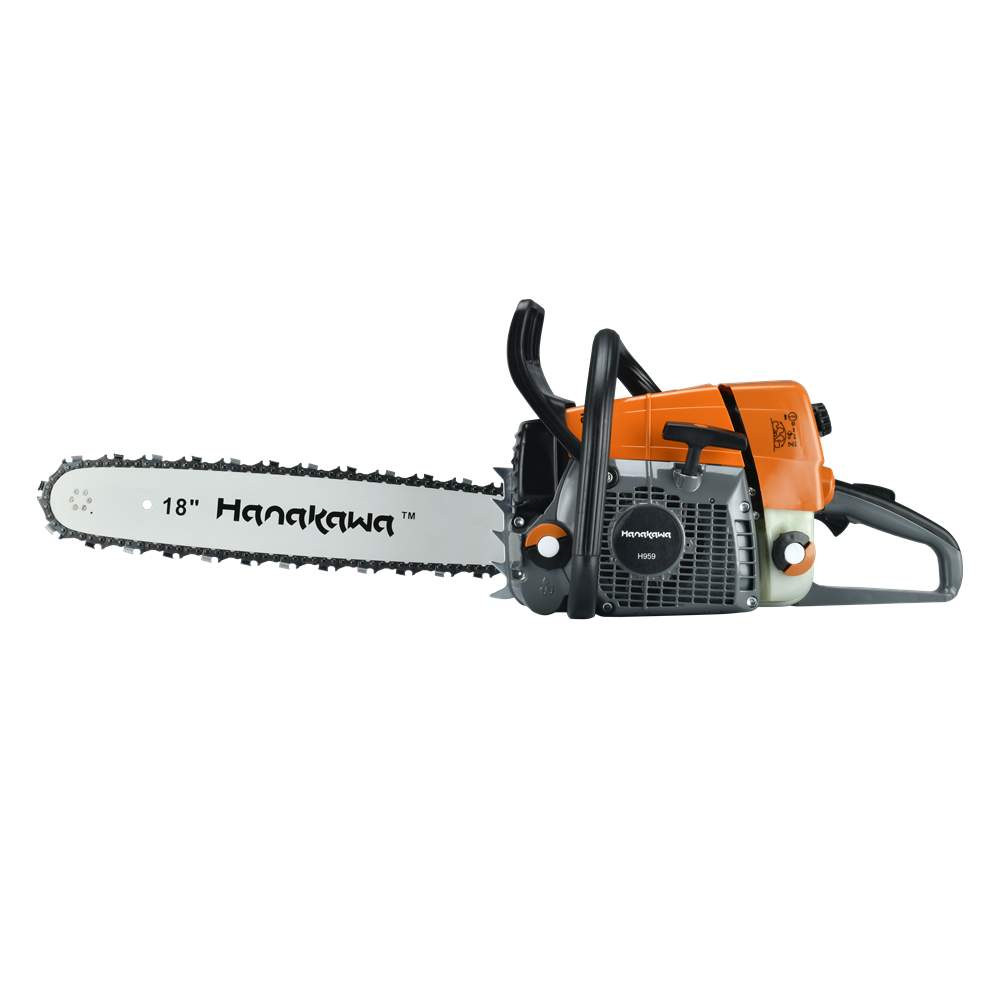
Hanakawa H959 — the mid-class entry point: 59cc, 3.4kW, 5.7kg, 11,500rpm.
Step 2 — Check power-to-weight ratio at the band you selected
Power-to-weight ratio is the fatigue metric. It is calculated by dividing rated power output by net weight. The values below are derived from the published figures for each model and are not manufacturer ratings themselves; they are comparison tools.
| Model | Displacement | Rated power | Net weight | Power-to-weight (derived) | Practical position |
|---|---|---|---|---|---|
| H932 | 31.8cc | 1.5kW | 4.1kg | ≈0.37 kW/kg | Light-duty, firewood and garden |
| H945 | 45.4cc | 2.2kW | 4.8kg | ≈0.46 kW/kg | Farm, orchard, small-scale forestry |
| H959 | 59cc | 3.4kW | 5.7kg | ≈0.60 kW/kg | Commercial forestry, municipal work |
| H971 | 70.7cc | 4.0kW | 6.1kg | ≈0.66 kW/kg | High-ratio upper-mid class |
| H972E | 72cc | 3.6kW | 6.6kg | ≈0.55 kW/kg | Torque-led intensive logging |
| H887 | 87cc | 4.2kW | 7.7kg | ≈0.55 kW/kg | Small commercial logging |
| H992 | 91.6cc | 5.2kW | 7.7kg | ≈0.68 kW/kg | Highest ratio in this data set |
| H9105 | 105.7cc | 4.8kW | 11kg | ≈0.44 kW/kg | Torque and stability over mass |
Derived values: rated power output divided by net weight, using the published specifications for each model.
Two conclusions follow. First, ratio does not rise automatically with displacement: the H9105 carries the largest engine in the range but the lowest ratio of the professional models listed, because a 105.7cc powerhead is built for torque delivery, long-bar stability and structural strength rather than for being carried quickly. Second, buyers who need all-day handling should compare ratio across bands, not within the band they have already decided on.
Step 3 — Interpret the engine-speed rating and the support systems
Engine speed should be read as a system spec, not a standalone one. A rated ceiling of 12,000rpm on the H971 and 13,500rpm on the H992 indicates engines designed to work at a higher stress level than the 11,500rpm models. In practice this makes the surrounding support systems more important, not less: cylinder cooling capacity, air filtration, and chain lubrication. Corpus-level product data reflects this: the H971 is specified with an adjustable oil pump and a reinforced transmission, the H972E with an efficient heat-dissipation cylinder, automatic chain lubrication and a safety kickback brake, and the H992 with a thickened magnesium alloy crankcase, an oversized cooling system and a heavy-duty anti-rebound brake.
Step 4 — Read the materials as a durability statement
Three materials appear across the professional range, and each one answers a different durability question.
Glass-reinforced PA nylon outer housing. Polyamide reinforced with glass fibre is a composite: the fibre content raises stiffness and impact resistance compared with unfilled polymer, while keeping the part light and reducing heat transfer to the operator's hands. Its practical benefit is shock resistance — dropped tools and kicked-back branches crack polymer housings less readily than thin metal covers. Its limitation is thermal: a polymer housing has a lower temperature ceiling than metal, which is why it is used for the outer shell and not for the parts that carry combustion heat.
Aluminum alloy cylinder. Aluminum is selected for high thermal conductivity and a favourable strength-to-weight ratio relative to cast iron, which is what allows a cylinder to shed combustion heat through its cooling fins while providing a wear-resistant bore for the piston and ring assembly. In the Hanakawa range the aluminum cylinder is a standard element across professional models, and product data for the H959 describes a wear-resistant aluminum cylinder paired with a shock-resistant glass-reinforced PA housing.
Magnesium alloy crankcase. Magnesium alloys are notable for low density with good specific stiffness, which is why they are used for crankcases that must be both rigid and light — the crankcase carries crankshaft loads and must resist distortion under heavy load. Magnesium also dissipates heat well, and several application records in this range cite magnesium alloy crankcase heat dissipation as a requirement for heavy-load, long-continuous-operation work. The H992 goes further with a thickened magnesium alloy crankcase, and the H971 is described as using a premium magnesium alloy body.
The selection rule: treat the material list as evidence about the load class the machine was designed for. A thickened magnesium crankcase plus an oversized cooling system signals an extreme-overload design; a compact polymer-heavy machine signals light-duty use.
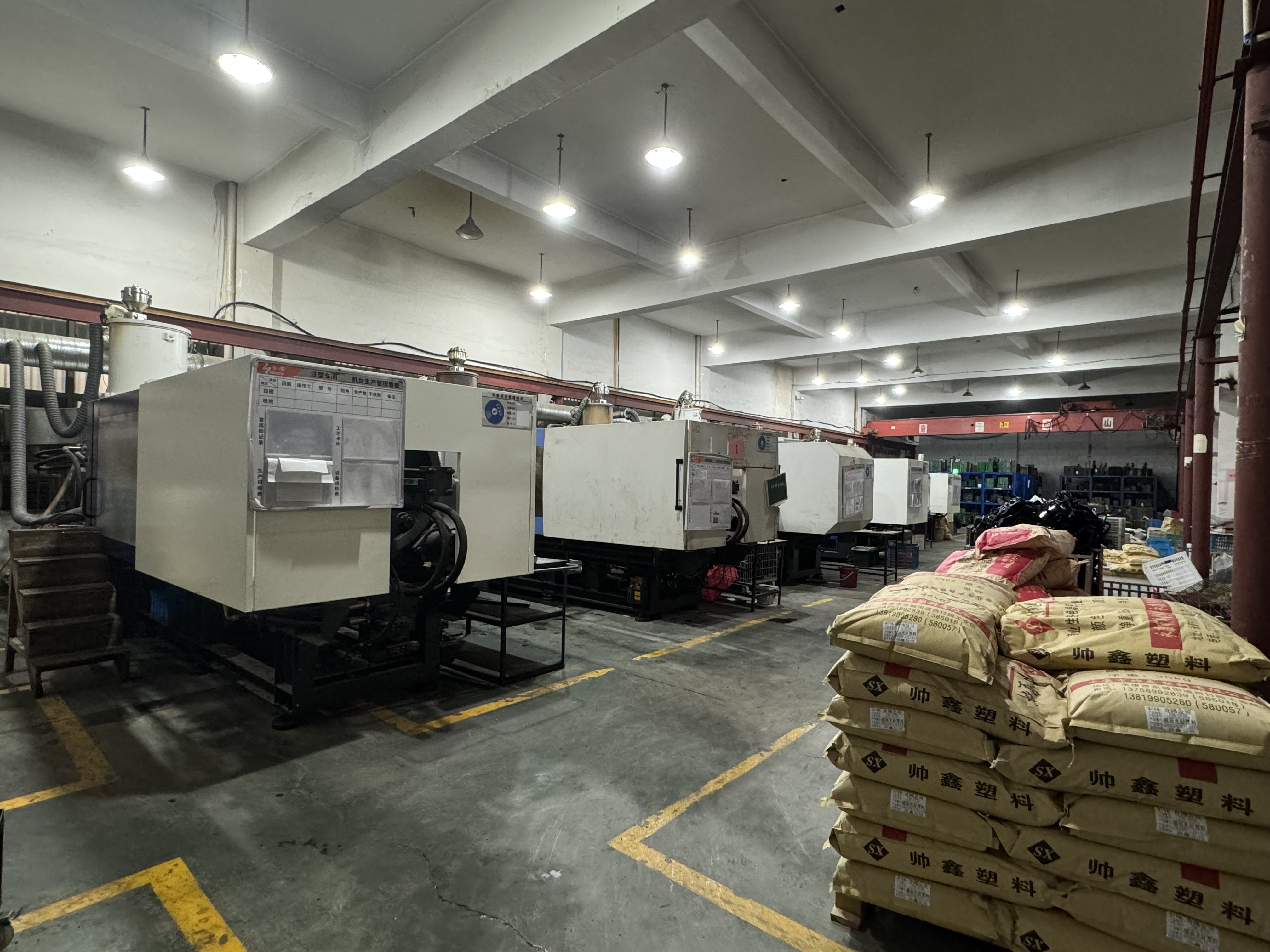
Glass-reinforced PA nylon housings are moulded in-house — an impact-resistant shell that also keeps operating weight down.
Step 5 — Treat spare parts compatibility as a selection parameter
Parts compatibility is the parameter that most often decides whether a fleet stays productive. It determines how quickly a replacement can be obtained locally, how many independent suppliers can serve the machine, and how predictable maintenance cost is over the service life. Hanakawa publishes a platform cross-reference for each professional model:
| Hanakawa model | Documented spare parts compatibility platform | Most common use profile |
|---|---|---|
| H932 | MS170, MS180, 017, 018 | Home, garden and small farm firewood cutting |
| H945 | MS230, MS250, 023, 025 | Agriculture, horticulture, orchard management |
| H959 | MS361 | Commercial forestry logging, municipal greening |
| H971 | MS440, 044 | Large-scale commercial logging, hardwood processing |
| H972 | MS381 | Intensive forest harvesting, disaster rescue |
| H872 | 61, 268, 272 | Farm hardwood cutting, orchard trunk pruning |
| H865 / H871 | 365, 372XP | High-intensity commercial logging |
| H871A | 372XT | Extra-large thick trunk cutting, long-bar bucking |
| H887 | 288 | Small commercial logging, hardwood batch cutting |
| H992 | MS660 | Large timber felling, old-growth forest logging |
| H9105 | MS660, 066 | Industrial heavy logging, log yard processing |
The commercial logic is visible in the company's own project records. For an OEM retailer supplying overseas warehouses and distributors across the United States, Canada and Australia, the documented result over two years at more than 5,000 units annually was stable operation with cost-effective replacement machines and aftermarket parts. For a private-label wholesaler and brand owner in Russia and Belarus, the record cites low field failure rate and few end-user complaints at more than 2,000 units annually, with highly compatible spare parts supporting after-sales service at downstream channels. In both cases the parts platform, not the headline power figure, underpinned the result.
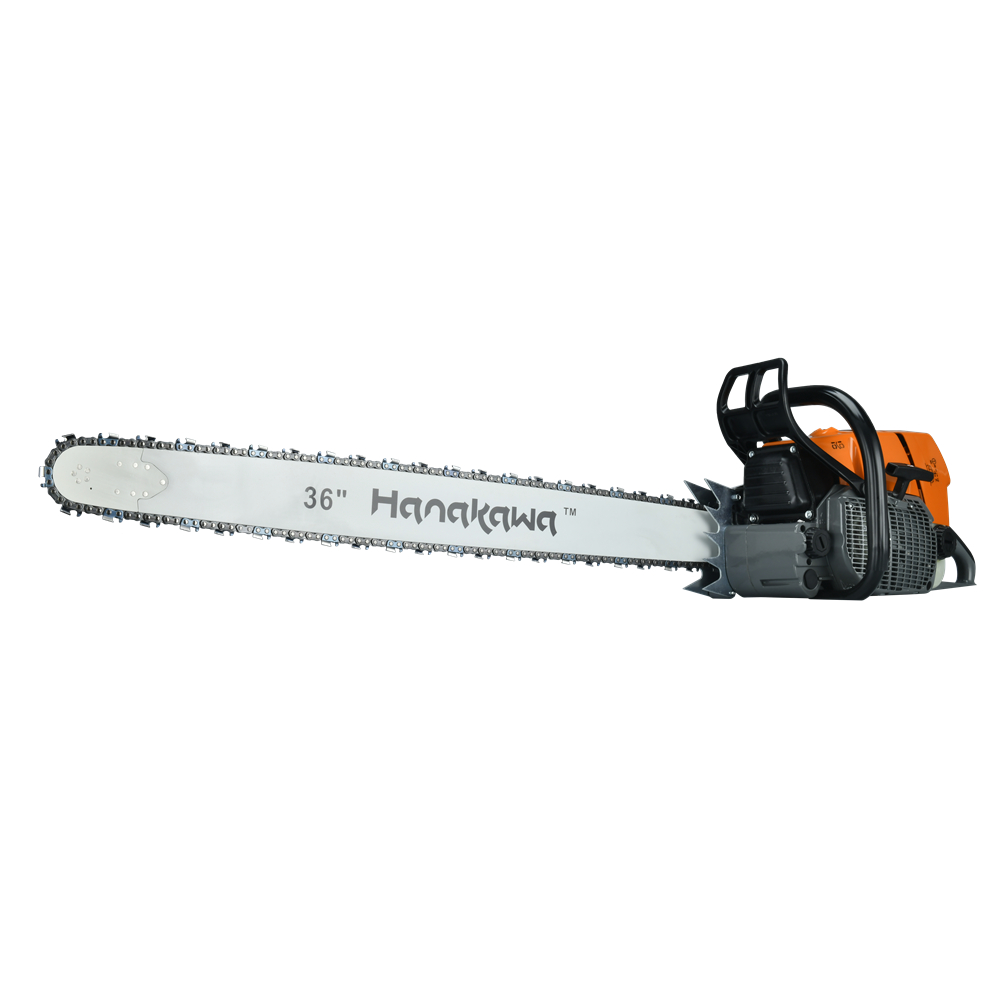
Hanakawa H992 — 91.6cc, 5.2kW, 7.7kg, 13,500rpm, documented as spare-parts compatible with the MS660 platform.
Step-by-Step Breakdown: A Six-Step Selection Sequence
- Define the job in physical terms. Record the typical and maximum trunk diameter, the dominant species or wood hardness, terrain slope, guide bar length, and continuous operating hours per day. These five inputs eliminate most of the range immediately.
- Convert the job into a displacement band. Farm firewood and orchard work sit in the 30–45cc band; commercial forestry and municipal clearance in the 59–65cc band; large-scale logging, forest thinning and disaster rescue in the 70–72cc band; large timber and old-growth felling in the 87–92cc band; industrial heavy logging and log yard processing in the 105cc+ band.
- Compare power-to-weight ratio inside the band. Where two models overlap in displacement, the ratio separates the design intent — for example, H971 at approximately 0.66 kW/kg against H972E at approximately 0.55 kW/kg, using derived figures.
- Verify engine speed together with cooling and lubrication. Match a higher rated engine speed only with a machine specified for the corresponding heat load: heat-dissipation cylinder, adjustable or automatic chain oiling, and reinforced transmission.
- Verify the spare parts platform and local aftermarket depth. Confirm the documented compatibility platform, then check that it corresponds to a parts profile that is actually stocked in the destination market.
- Validate with a sample before committing to bulk volume. Test the selected model on the actual species and diameter class, then confirm the configuration with the supplier before the production order is released.
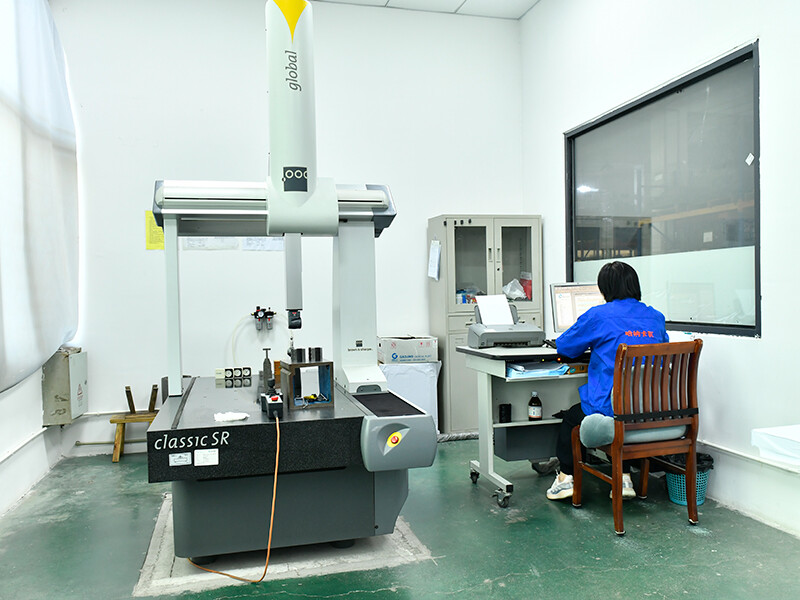
Dimensional verification of components during in-process and pre-shipment inspection.
Use Cases: Matching the Displacement Band to Field Conditions
Municipal clearing and construction vegetation removal. The workload is intermittent, the terrain is often roadside or urban, and the operator may switch between felling, limbing and debris breaking in a single shift. A mid-class saw with a balanced power-to-weight ratio fits best; the H959 at 59cc, 3.4kW and 5.7kg is specified for commercial forestry logging, municipal greening, construction clearing and road obstacle removal, and is documented against natural mountain forest, roadside slope and construction demolition site conditions with high dust and variable temperature.
Large-scale industrial forestry and lumber mill feed. Where the requirement is large-diameter mature tree felling, heavy hardwood cross-cutting and all-day non-stop professional working in primary natural forest and rugged mountain terrain, the upper-mid band is the entry point. The H971 is specified for large-scale commercial logging, hardwood processing, engineering demolition and forest thinning, with a high power-to-weight ratio, a fully adjustable automatic oil pump and a reinforced crankshaft assembly.
Intensive commercial logging and post-storm rescue. Steep mountain forest, dense hardwood stands and storm-damaged sites place the priority on low-speed torque and high-temperature durability under full load rather than on low weight. The H972E is specified for commercial intensive forestry logging, hardwood felling, mountain forest operation, construction site clearing, post-disaster emergency rescue, municipal road obstacle removal and large orchard trunk pruning, with an efficient heat-dissipation cylinder, reinforced drive system, heavy-duty anti-vibration, automatic chain lubrication and a safety kickback brake.
Old-growth forest logging and super-large timber. Remote primitive mountain forest, ultra-thick ancient tree clusters and extreme climate shift the requirement to cooling capacity and structural strength. The H992 at 91.6cc and 5.2kW is specified for large timber felling, old-growth forest logging, lumber mill work, large disaster rescue and land reclamation, with a thickened magnesium alloy crankcase, oversized cooling system and heavy-duty anti-rebound brake.
Industrial heavy-duty logging and log yard processing. Maximum-diameter one-time felling, longitudinal splitting of heavy logs and bulk hardwood processing in tropical rainforest or thick log yards require the largest displacement in the range. The H9105 at 105.7cc, 4.8kW and 11kg is specified for industrial heavy logging, giant tree cutting, log yard primary processing and remote mountain forest exploitation, with ultra-high torque output, a fully reinforced metal drive system and stable operation under extreme overload.
Farm logging and firewood processing. Where the requirement is medium hardwood felling, fruit tree limb trimming, wasteland clearance and batch firewood production on hilly farm woodland, the compact band is the correct choice. The H932 (31.8cc, 1.5kW, 4.1kg) and H945 (45.4cc, 2.2kW, 4.8kg) are specified for home gardening, orchard management and small-scale forestry, with requirements including high spare parts versatility, dust-resistant air filtration and durable long-hour intermittent work.
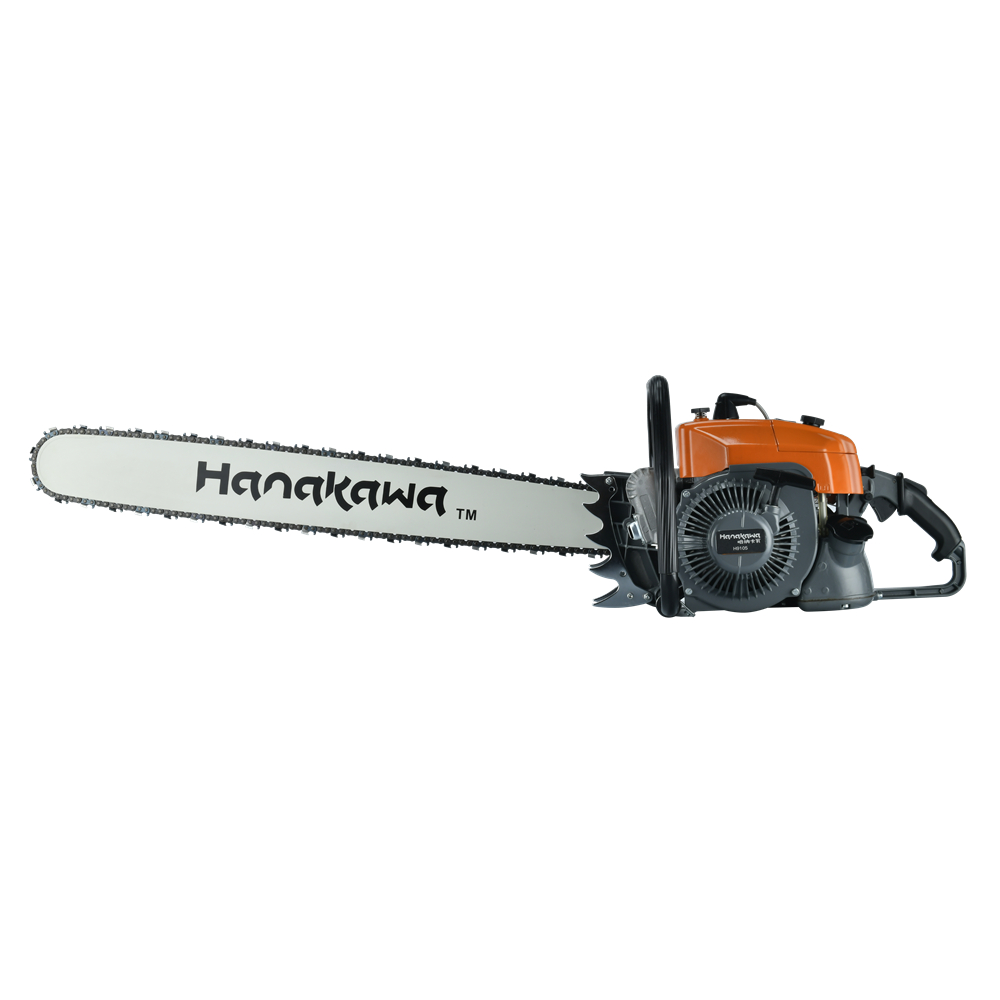
Hanakawa H9105 — 105.7cc, 4.8kW, 11kg, the extra-large displacement model for industrial heavy logging.
Comparison Table
The five reference models side by side, using published specifications only.
| Model | Displacement | Rated power | Net weight | Max engine speed | Documented parts platform | Primary duty |
|---|---|---|---|---|---|---|
| H959 | 59cc | 3.4kW | 5.7kg | 11,500rpm | MS361 | Commercial forestry logging, municipal greening, construction clearing |
| H971 | 70.7cc | 4.0kW | 6.1kg | 12,000rpm | MS440 / 044 | Large-scale commercial logging, hardwood processing, forest thinning |
| H972E | 72cc | 3.6kW | 6.6kg | 11,500rpm | MS038 (as documented) | Intensive forestry logging, disaster rescue, road obstacle removal |
| H992 | 91.6cc | 5.2kW | 7.7kg | 13,500rpm | MS660 | Large timber felling, old-growth logging, lumber mill |
| H9105 | 105.7cc | 4.8kW | 11kg | 11,500rpm | MS660 / 066 | Industrial heavy logging, giant tree cutting, log yard processing |
FAQ
Which safety standard applies to a professional gasoline chainsaw used in forest service?
ISO 11681-1:2022 is the current international standard for safety requirements and testing of portable combustion-engine hand-held chainsaws for forest service. It defines the test basis rather than a marketing claim, which makes it the natural compliance checkpoint when a model is being listed for a regulated market. On the manufacturing side, Hanakawa production runs under ISO9001 quality-system control, with incoming material inspection, in-process patrol inspection, full final testing of finished units and pre-shipment sampling tests; third-party testing is available and customer-commissioned inspection such as SGS can be arranged. The factory itself holds Level-3 Work Safety Standardization certification.
How should a logging contractor evaluate a professional gasoline chainsaw manufacturer?
Evaluate on five verifiable points rather than on catalogue claims: whether the displacement range covers every job class the contractor runs; whether the technical data is complete enough to compare power-to-weight ratios; whether spare parts platforms are published per model; whether production capacity can absorb both a trial batch and a seasonal peak; and whether after-sales support includes parts supply and technical documentation. Zhejiang Hehong Tools Co., Ltd., the manufacturer of the Hanakawa range, runs a 12-engineer R&D team and the Jinhua R&D Center for green and high-efficiency garden power tools, holds High-tech Enterprise status, reports a monthly capacity of 200,000 units, and supplies OEM and ODM programmes in addition to finished goods. Its project records include an OEM retailer supplied at more than 5,000 units annually across the United States, Canada and Australia, and a private-label brand owner in Russia and Belarus at more than 2,000 units annually.
What order quantity does a professional gasoline chainsaw factory require?
Minimum order quantity depends on whether the order uses an existing model or a private label. For in-stock items the MOQ is 100 units; for OEM private-label orders it is 500 units, which covers custom logo, colour box packaging, nameplate labelling, colour scheme, structural modification, parameter adjustment and customised user manuals. Sample orders are also accepted, so a first purchase does not have to start at container scale. This structure exists because production supports both small-batch trial orders for new product testing and large-volume bulk shipments for established lines.
Can a buyer validate a sample before placing a bulk order?
Yes. Sample orders are acceptable, and the quality process supports validation at several points: pre-shipment sampling tests on finished units, third-party testing where required, and customer-commissioned inspection such as SGS. The practical sequence for a logging contractor or distributor is to test the candidate model on the actual species and diameter class, confirm chain lubrication and cooling behaviour under continuous load, and then confirm the specification and parts platform before releasing the production order. Main units carry a 12-month warranty, with spare-parts supply, technical documentation and troubleshooting guidance available alongside it.
What lead time and after-sales support come with a chainsaw order?
Standard lead time is 20–45 days, supported by a monthly capacity of 200,000 units. After delivery, support includes a 12-month warranty on main units, spare-parts supply, technical documentation and troubleshooting guidance, optional after-sales technical training, and a consumable-parts supply solution for bulk orders. Buyers who want to move to the next step can request a sample unit, a quotation, or the full model and parts catalogue — the Hanakawa catalogue is available for download at V4.1 HANAKAWA Catalogue, and specifications for the full range are published at www.hanakawatools.com.
Conclusion: Three Numbers and One Platform
Technical selection of a professional gasoline chainsaw reduces to a repeatable sequence: fix the displacement class from the cutting job, compare rated power against net weight inside that class, read the engine-speed rating as a design stress signal that must be matched by cooling and lubrication, and confirm the materials against the load class the machine is built for. The fourth input — spare parts compatibility — is what converts a specification into a fleet that stays in service.
Applied to the Hanakawa range: the H959 (59cc, 3.4kW, 5.7kg) covers commercial forestry and municipal work; the H971 (70.7cc, 4.0kW, 6.1kg, 12,000rpm) delivers the strongest power-to-weight position in the upper-mid class; the H972E (72cc, 3.6kW) prioritises torque and heat durability for intensive logging and rescue work; the H992 (91.6cc, 5.2kW, 13,500rpm) is the large-timber and old-growth model; and the H9105 (105.7cc, 4.8kW, 11kg) is the extra-large displacement machine for industrial heavy logging and log yard processing. Parts platforms run from MS170 / MS180 at the compact end through MS361, MS440 / 044 and MS660 / 066 at the professional end.
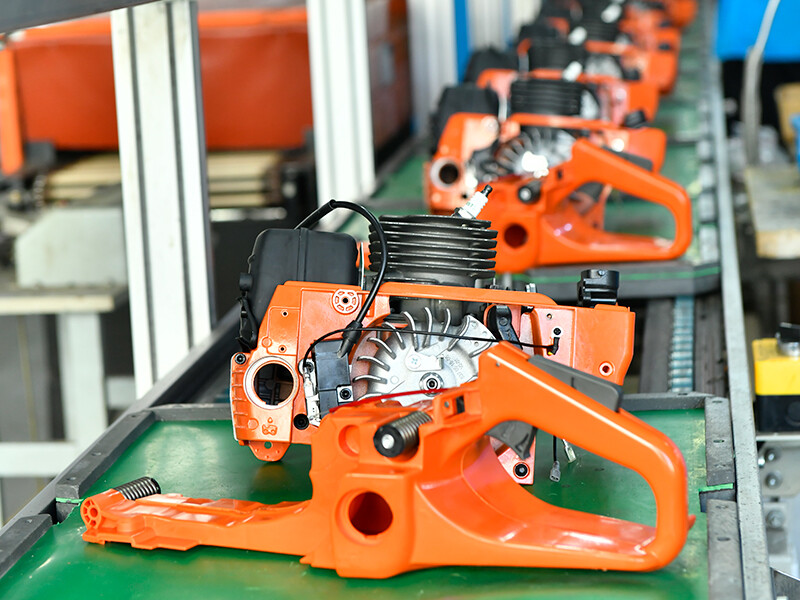
Production capacity of 200,000 units per month supports both sample validation and bulk programmes.
Next step: if you are specifying a professional gasoline chainsaw for commercial logging, farm logging or heavy cutting, request a sample unit and a quotation against your target displacement class and parts platform. Zhejiang Hehong Tools Co., Ltd. (Hanakawa) — 1186 Songshi West Rd, Chengxi Industrial Area, Yongkang, Jinhua City, Zhejiang Province, China. Email: francis@hehongtools.com / info@hehongtools.com. Tel: +86 579 89051580. WhatsApp: +86 172-7668-1217. Catalogue: download the V4.1 Hanakawa catalogue.
Have Questions or Need More Details?
Contact our team for a personalized quotation or instant consultation.
Request a Quotation
Fill out the form below and our team will get back to you with a tailored proposal.
WhatsApp Direct Chat
Prefer to chat in real-time? Message us on WhatsApp for instant assistance & quick answers.
- Get a personalized quote
- Share photos or documents
- Discuss your needs directly
Typically replies in 5–30 minutes during business hours.