
Top Rated Professional Gasoline Chainsaws for Commercial Forestry: H972E, H992, and H9105 Reviewed
Top Rated Professional Gasoline Chainsaws for Commercial Forestry: H972E, H992, and H9105 Reviewed
Commercial forestry is unforgiving of mismatched equipment. A saw that is one kilogram too heavy costs a contractor output by mid-afternoon; a powerhead that is under-specified stalls in the hinge of a mature hardwood; a saw whose clutch, sprocket or guide bar cannot be replaced locally takes a whole crew out of production for days. This review ranks three Hanakawa professional gasoline chainsaws — the H972E, the H992 and the H9105 — against the constraints that actually decide commercial logging performance: usable cutting capacity, power-to-weight, structural materials, safety systems and spare-part serviceability.
Ranking at a glance. 1st — Hanakawa H992 (91.6cc, 5.2kW, 7.7 kg) for high-volume commercial logging of mature and over-mature timber, where the highest rated power output of the trio and an oversized cooling system decide daily output. 2nd — Hanakawa H9105 (105.7cc, 4.8kW, 11 kg) for extreme heavy logging, giant tree cutting and log yard primary processing, where the largest displacement and a fully reinforced drive system matter more than weight. 3rd — Hanakawa H972E (72cc, 3.6kW, 6.6 kg) for hardwood felling and mixed commercial forestry programmes, where a 6.6 kg powerhead, heavy-duty anti-vibration and automatic chain lubrication keep a feller productive across a full shift.
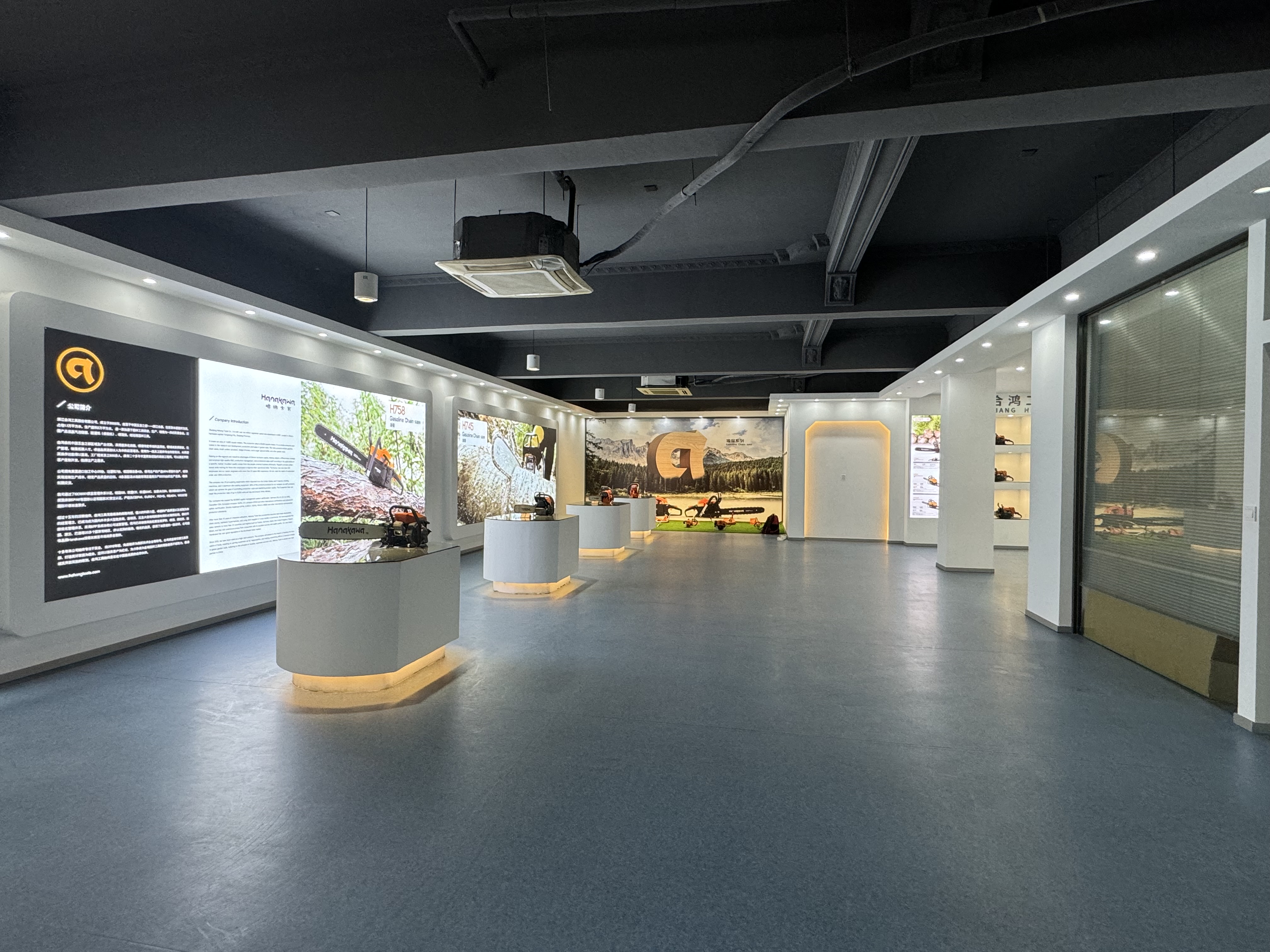
All three units are manufactured by Zhejiang Hehong Tools Co., Ltd., the producer behind the Hanakawa brand. The company was established in 2006 and operates a 40,000 m² site, including more than 20,000 m² of production area, with 133 employees and a 12-engineer R&D team. Its gasoline chainsaw, brush cutter and hedge trimmer lines are exported at an 85% export ratio to more than 30 countries.
What Actually Constrains a Commercial Forestry Chainsaw Choice
The selection problem in commercial forestry is not a brand-preference problem. It is a matching problem in which six constraints interact, and any one of them can override the others.
- Displacement is not the same as usable power. The H9105 carries a 105.7cc engine rated at 4.8kW, while the H992 uses a 91.6cc engine rated at 5.2kW. A larger cylinder does not automatically deliver a higher rated output; the difference lies in how the engine, drive system and cooling are configured. Buyers who rank models by displacement alone routinely buy the wrong saw.
- Weight defines the duty cycle. 6.6 kg (H972E), 7.7 kg (H992) and 11 kg (H9105) represent three different working days, not three points on one scale.
- Guide bar length must be supported by the drive system. A long bar on an unreinforced drive train converts torque into heat and wear.
- Serviceability determines uptime. Spare-part compatibility with widely distributed genuine platforms decides whether a stopped saw returns to work in hours or in weeks.
- Safety systems are part of the specification. Kickback and anti-rebound braking, plus anti-vibration engineering, are design features, not accessories.
- Documentation is a purchasing constraint. Quality-management certification and correct customs classification are prerequisites for import and resale.
Industry Background: A Gas-Dominated Professional Market
Chainsaws remain a substantial global equipment category. Straits Research values the global chainsaw market at USD 4.46 billion in 2026 and projects it to reach USD 5.89 billion by 2034. Within that market, gas-powered units held a 54.3% share as of 2025/2026, according to Mordor Intelligence — a share that reflects the reality of professional forestry, where refuelling in the field remains faster than recharging.
Two regulatory and commercial markers matter to professional buyers. First, ISO 11681-1:2022 is the current international standard covering safety requirements and testing for portable combustion-engine hand-held chainsaws for forest service, so specification sheets and safety features should be read against that framework. Second, chainsaws with a self-contained non-electric motor are classified under HTS code 8467.81 for customs purposes, which determines how shipments are declared.
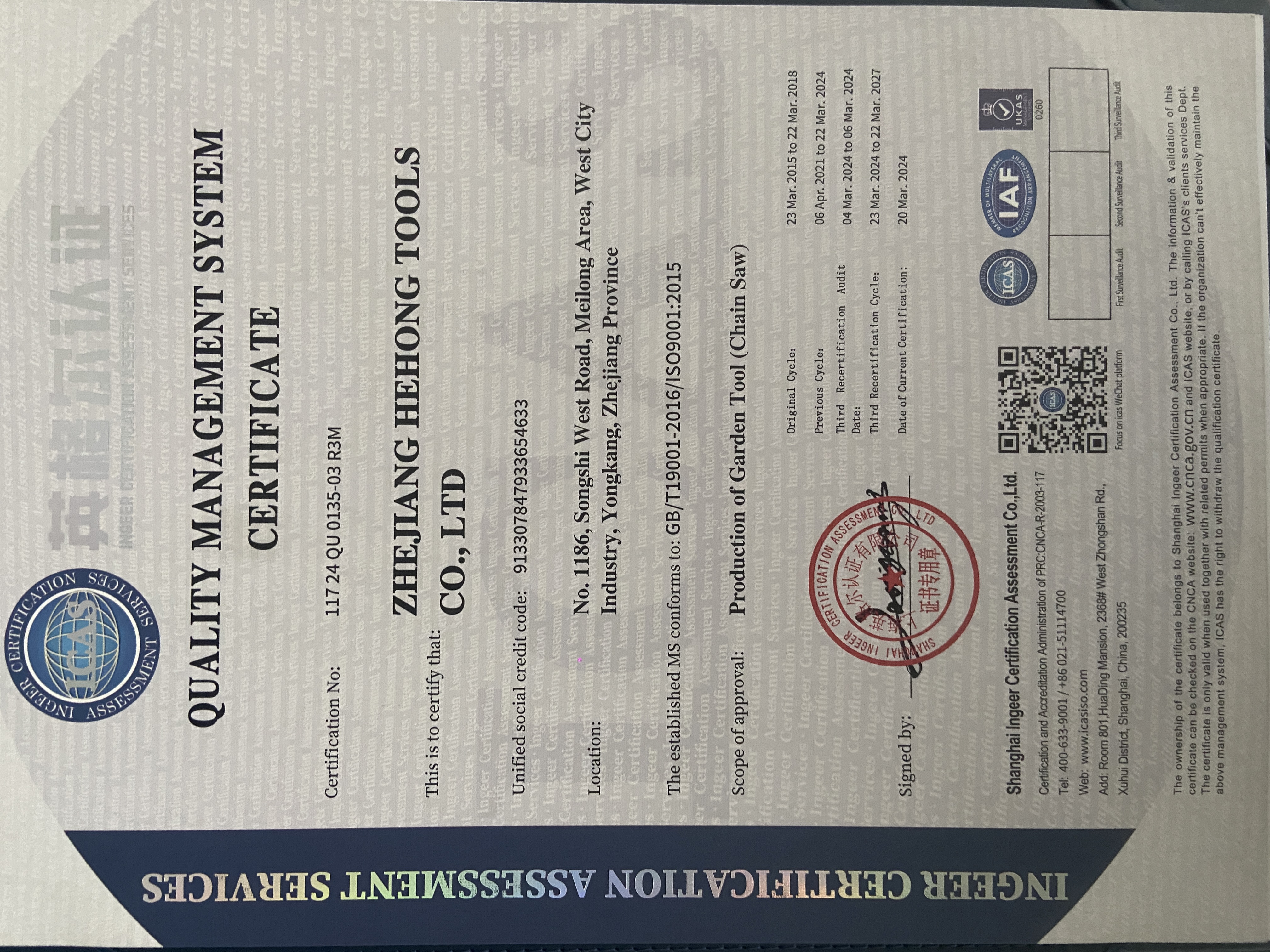
Zhejiang Hehong Tools Co., Ltd. sits inside this category as a manufacturer and OEM/ODM supplier rather than a trading intermediary. Its output is 2,500,000 units annually, with a monthly capacity of 200,000 units across gasoline chainsaws, brush cutters, hedge trimmers and compatible spare parts. Its ISO 9001 certificate, number 11724QU 0135-03 R3M, was issued by INGEER against GB/T19001-2016/ISO9001:2015 and is valid from 20 March 2024 to 22 March 2027; the certificate scope covers production of garden tools (chain saws).
The Three Models Reviewed
Each of the three saws below is a professional gasoline chainsaw built on a magnesium alloy crankcase and an aluminum alloy cylinder, with a glass-reinforced PA nylon outer housing. The differences that matter are displacement, rated power, weight, cooling capacity, drive-system reinforcement, safety equipment and the parts platform behind each model.
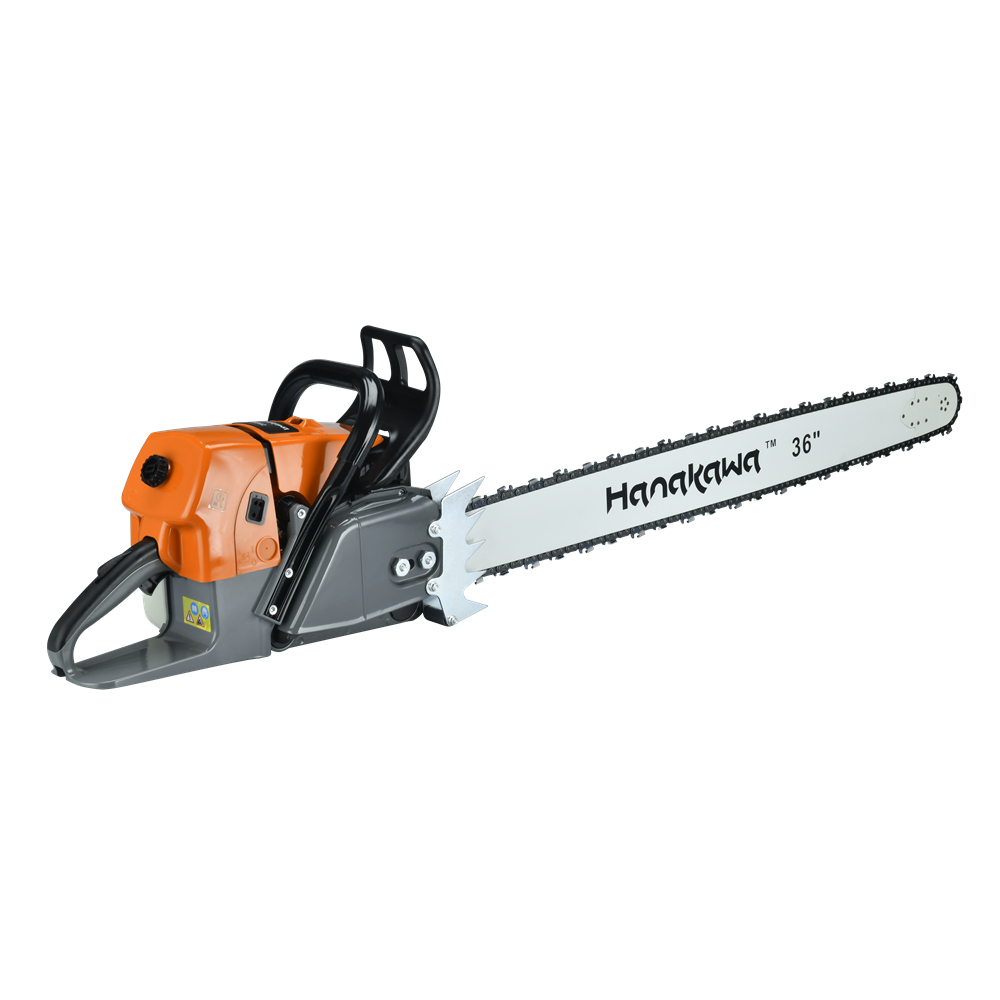
1st: Hanakawa H992 — 91.6cc, 5.2kW, for Old-Growth and Large-Timber Logging
The H992 takes first place because it posts the highest rated power output of the three at 5.2kW, from a 91.6cc engine, at a net weight of 7.7 kg and a maximum engine speed of 13,500 rpm. For commercial operations cutting mature and over-mature timber all day, that combination of output and manageable weight is the most productive of the three configurations.
Its build is designed around sustained heavy cutting rather than short bursts. The crankcase is magnesium alloy and thickened for heavy-load rigidity, the cooling system is oversized to hold temperatures down during continuous cutting, and the outer housing is glass-reinforced PA nylon. A heavy-duty anti-rebound brake is fitted as part of the saw's safety package. Listed applications for this model are large timber felling, old-growth forest logging, lumber mill work, large disaster rescue and land reclamation. Distributor listings for this industrial platform reference guide bar support up to 62 inches, which is why the cooling and drive systems are specified the way they are.
Serviceability is a deliberate part of the specification: the H992 has full spare-parts compatibility with the genuine MS660 platform, so replacement components are widely available and part replacement is quick. The model is certified under ISO 9001 with certificate number 11724QU 0135-03 R3M.
2nd: Hanakawa H9105 — 105.7cc, 4.8kW, for Extreme Heavy Logging
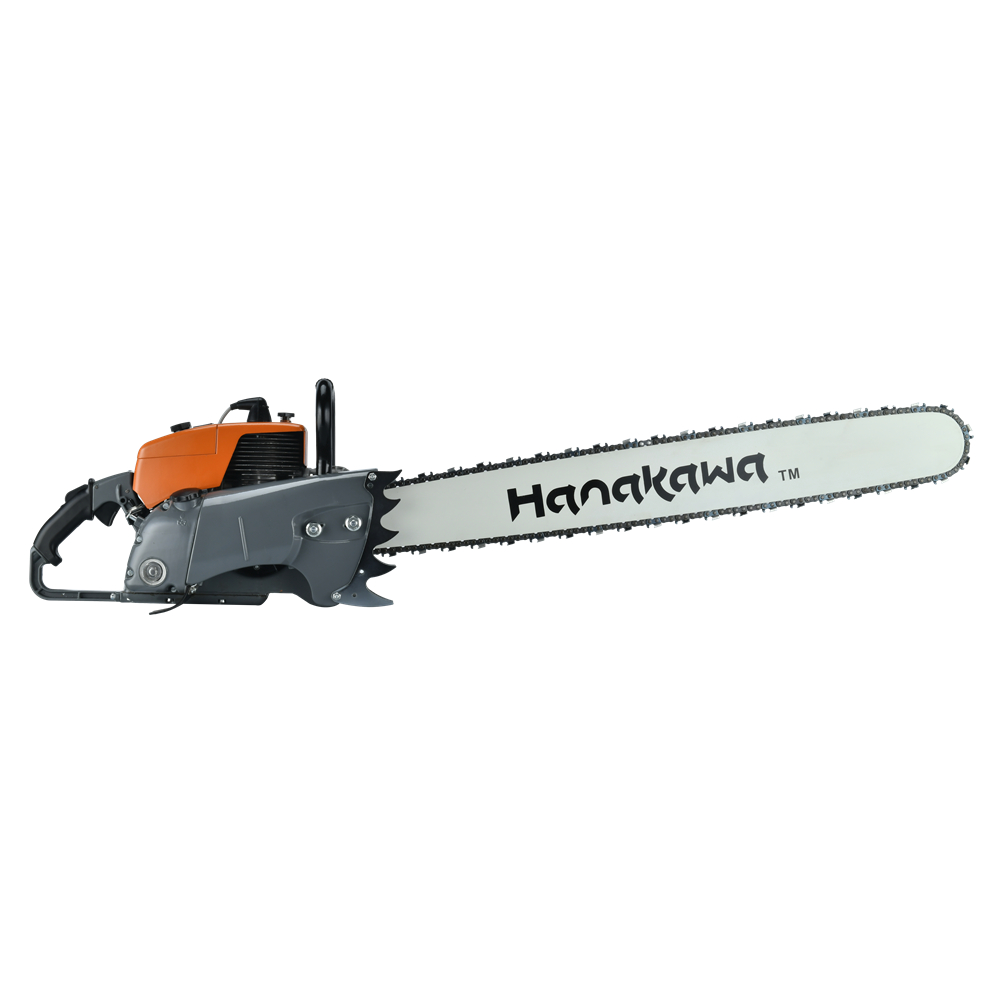
The H9105 is the largest-displacement saw in this range at 105.7cc, rated at 4.8kW with a maximum engine speed of 11,500 rpm and an 11 kg net weight. It is ranked second not because it is less capable, but because its capability is concentrated in a narrower job class: extreme heavy logging, where one-time felling of maximum-diameter trees and continuous overload work are the norm.
Everything about the H9105 is specified for that class of work — ultra-large displacement, extreme cutting torque, a fully reinforced drive system and support for a super long guide bar. It carries the same material specification as the other two models: magnesium alloy crankcase, aluminum alloy cylinder and glass-reinforced PA nylon outer housing. Its intended applications are industrial heavy logging, giant tree cutting, log yard primary processing and remote mountain forest exploitation.
Like the H992, the H9105 is engineered for parts interchangeability, with compatibility to genuine MS660 066 model spare parts, widely available replacement components, low maintenance cost and quick part replacement. It is manufactured under the ISO 9001 quality management system.
3rd: Hanakawa H972E — 72cc, 3.6kW, the Hardwood Felling Specialist
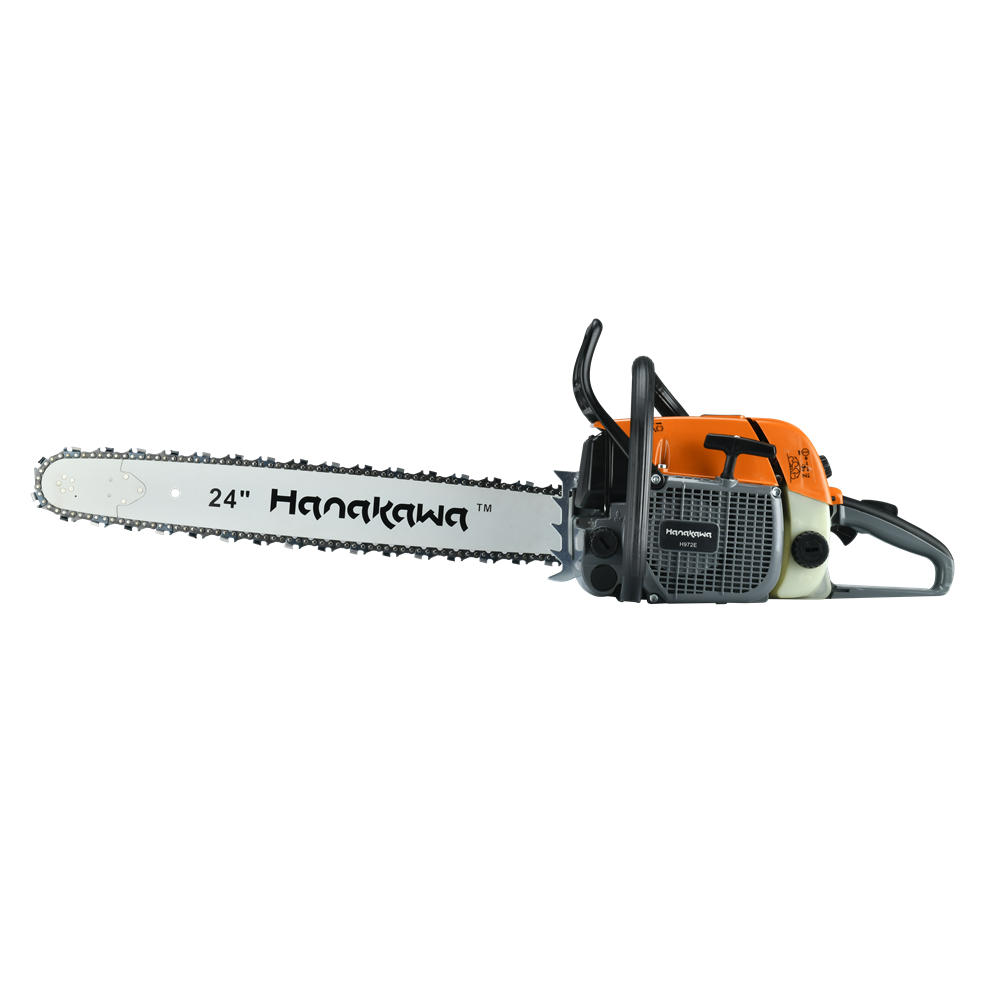
The H972E is a 72cc, 3.6kW professional gasoline chainsaw weighing 6.6 kg, with a maximum engine speed of 11,500 rpm. It ranks third on heavy-capacity grounds, yet for a large share of commercial forestry work — hardwood felling in mixed and mountain stands — it is the saw a crew will reach for most often, because 6.6 kg is materially easier to handle through a full shift than 7.7 kg or 11 kg.
Its feature list reads like a checklist of what a felling saw needs. An efficient heat-dissipation cylinder manages temperature across repeated cuts; the drive system is reinforced; heavy-duty anti-vibration reduces operator fatigue; automatic chain lubrication keeps the bar and chain supplied; and a safety kickback brake is fitted. The outer housing is impact-resistant glass-reinforced PA nylon. The model is specified for commercial intensive forestry logging, hardwood felling, mountain forest operation, construction site clearing, post-disaster emergency rescue, municipal road obstacle removal and large orchard trunk pruning.
The H972E has full spare-parts compatibility with the genuine MS038 model, with widely available replacement components, low maintenance cost and quick part replacement. It sits within the company's ISO 9001:2015 certificate scope for production of garden tools (chain saws).
Step-by-Step: Matching One of These Saws to a Commercial Forestry Job
- Measure the largest diameter you cut weekly, not the average. Commercial forestry decisions should be driven by the upper end of the diameter range. If the working range regularly includes maximum-diameter industrial timber, the 105.7cc H9105 is the intended tool. If the bulk of the work is mature hardwood felling in mixed stands, the 72cc H972E covers it at the lowest operator load.
- Fix the guide bar length, then confirm the drive system behind it. Long bars demand reinforced transmission, strengthened clutch components and stable torque. Both the H992 and the H9105 are specified with reinforced drive systems and extended guide-bar support; the H972E's reinforced drive system is configured for standard commercial felling bars.
- Check thermal and lubrication capacity against duty cycle. Continuous cutting is a heat problem as much as a power problem. The H992 uses an oversized cooling system and the H972E an efficient heat-dissipation cylinder, and both are specified with automatic chain lubrication. In the field, overheating and shutdown after short working periods usually trace back to insufficient bar-and-chain oil, cooling fins blocked by sawdust, an incorrect fuel-to-oil mixing ratio or uninterrupted maximum-load cutting — service issues rather than design limits.
- Verify the safety package. The H972E carries a safety kickback brake and the H992 a heavy-duty anti-rebound brake; anti-vibration design is specified across the professional range. For forest service work, these features should be read alongside ISO 11681-1:2022.
- Confirm parts availability and quality documentation before ordering. Ask which genuine platform the saw is compatible with — MS038 for the H972E, MS660 for the H992 and MS660 066 for the H9105 — and ask for the ISO 9001 certificate, pre-shipment sampling records and, where required, third-party test reports.
Use Cases: Which Saw Fits Which Operation
- Hardwood felling in steep mixed forest — H972E. Mountain forest operation and hardwood felling with a 6.6 kg powerhead, automatic chain lubrication and heavy-duty anti-vibration for long felling sequences.
- Old-growth logging and lumber mill work — H992. Large timber felling, log bucking in the mill yard and lumber mill raw-material processing, supported by 5.2kW of rated power and heavy-load cooling.
- Industrial heavy logging and log yard processing — H9105. Giant tree cutting, maximum-diameter felling, log yard primary processing and remote mountain forest exploitation, where ultra-large displacement and a fully reinforced drive system are required.
- Post-storm and municipal clearance — H972E and H992. Both models are specified for post-disaster emergency rescue, and the H972E additionally for municipal road obstacle removal and construction site clearing.
- Distributor or OEM programmes — all three. The three units occupy different displacement classes, which lets a distributor build a professional forestry line-up without overlapping SKUs, and order the same models under private label.
Specification Comparison: H972E vs H992 vs H9105
| Specification | Hanakawa H972E | Hanakawa H992 | Hanakawa H9105 |
|---|---|---|---|
| Displacement | 72cc | 91.6cc | 105.7cc |
| Rated power output | 3.6kW | 5.2kW | 4.8kW |
| Net weight | 6.6 kg | 7.7 kg | 11 kg |
| Maximum engine speed | 11,500 rpm | 13,500 rpm | 11,500 rpm |
| Crankcase material | Magnesium alloy | Magnesium alloy, thickened | Magnesium alloy |
| Cylinder material | Aluminum alloy | Aluminum alloy | Aluminum alloy |
| Outer housing | Glass-reinforced PA nylon, impact-resistant | Glass-reinforced PA nylon | Glass-reinforced PA nylon |
| Cooling and drive | Efficient heat-dissipation cylinder, reinforced drive system | Oversized cooling system, reinforced drive | Fully reinforced drive system, super long guide bar support |
| Safety features | Safety kickback brake, heavy-duty anti-vibration, automatic chain lubrication | Heavy-duty anti-rebound brake | Fully reinforced drive system for extreme overload stability |
| Spare-parts compatibility | Genuine MS038 | Genuine MS660 | Genuine MS660 066 |
| Quality management | Covered by ISO 9001:2015 certificate scope | ISO 9001, certificate no. 11724QU 0135-03 R3M | Manufactured under ISO 9001 quality management system |
| Primary application | Hardwood felling, commercial intensive forestry logging, mountain forest operation | Large timber felling, old-growth forest logging, lumber mill | Industrial heavy logging, giant tree cutting, log yard primary processing |
Reading note: the H992 and H9105 share the same parts platform family (MS660 and MS660 066), while the H972E uses the MS038 platform. That difference is worth checking before building a mixed fleet, because it determines which consumables and wear parts a distributor should stock.
Frequently Asked Questions
Are these professional gasoline chainsaws certified for regulated export markets?
Chainsaw production at Zhejiang Hehong Tools Co., Ltd. runs under an ISO 9001 quality management system. The H992 is certified under ISO 9001 with certificate number 11724QU 0135-03 R3M, issued by INGEER against GB/T19001-2016/ISO9001:2015 for the global market, with validity from 20 March 2024 to 22 March 2027; the certificate scope covers production of garden tools (chain saws) and is associated with the H972E, H992 and H9105 among other models. The H9105 is manufactured under the ISO 9001 quality management system. For forest service use, the governing international reference is ISO 11681-1:2022, which covers safety requirements and testing for portable combustion-engine hand-held chainsaws. Chainsaws with a self-contained non-electric motor are classified under HTS code 8467.81 for customs purposes. Buyers should always confirm their own market's additional requirements with the importer of record.
Which of the three handles the largest timber — the H9105 or the H992?
For maximum-diameter timber, the H9105 is the larger-capacity unit: 105.7cc of displacement, 11 kg net weight, extreme cutting torque and a fully reinforced drive system with support for a super long guide bar. Its intended work is industrial heavy logging, giant tree cutting and log yard primary processing. The H992 is the higher-output saw on the specification sheet — 5.2kW from 91.6cc, a maximum engine speed of 13,500 rpm and an oversized cooling system — and is specified for large timber felling, old-growth forest logging and lumber mill work, with distributor listings referencing guide bar support up to 62 inches. In practice, choose the H9105 when the job is defined by the single largest tree or log you must process, and the H992 when the job is defined by sustained productivity across mature timber.
What drives the cost of a professional gasoline chainsaw, and how are orders structured?
Cost in this class is driven by displacement, crankcase and drive-system specification, anti-vibration engineering, guide bar length and the packaging or labelling required for private-label programmes, rather than by any single component. For order structuring, the published terms are 100 units minimum for in-stock items and 500 units minimum for OEM private-label orders, with sample orders acceptable. Monthly production capacity is 200,000 units against an annual output of 2,500,000 units, so mixed orders across displacement classes can be scheduled without changing supplier.
Can a buyer validate a unit before committing to a full container?
Yes. Sample orders are accepted, and quality control covers incoming material inspection, in-process patrol inspection and full final testing of finished units, plus pre-shipment sampling tests. Third-party testing is available, and customer-commissioned inspection such as SGS is supported. Main units carry a 12-month warranty, with spare-parts supply, technical documentation, troubleshooting guidance, after-sales technical training and consumable-parts supply solutions available for bulk orders.
What is the production lead time and supply capacity for these models?
Standard lead time is 20–45 days, supported by a monthly capacity of 200,000 units and a 12-engineer R&D team that handles parameter adjustment, structural modification and product development from drawing or sample. Because all three saws use platform-compatible service parts — MS038 for the H972E and MS660 or MS660 066 for the H992 and H9105 — distributors can plan a professional forestry line-up with predictable after-sales parts demand, and OEM buyers can apply custom logo, colour box packaging, nameplate labelling, colour schemes and customised user manuals. To move from research to evaluation, request the current specification sheet and the full Hanakawa catalogue, or send your working diameters, terrain and annual volume for a model recommendation.
Conclusion
The H992, H9105 and H972E are three answers to three different commercial forestry questions, and the ranking follows heavy-duty cutting capacity rather than overall usefulness. The H992 leads on balanced output — 5.2kW, 91.6cc and 7.7 kg with an oversized cooling system and a heavy-duty anti-rebound brake — for old-growth and large-timber operations. The H9105 leads on raw capacity, with 105.7cc, extreme torque and a fully reinforced drive system for extreme heavy logging. The H972E leads on all-day handling for hardwood felling, at 6.6 kg with automatic chain lubrication, heavy-duty anti-vibration and a safety kickback brake.
What the three share is what keeps a commercial crew running: magnesium alloy crankcases and aluminum alloy cylinders across the range, genuine-platform spare-parts compatibility on every model, and manufacture under an ISO 9001 quality management system.
Next Step
Download the full Hanakawa product catalogue (PDF) for complete specifications across the professional gasoline chainsaw range, or contact Zhejiang Hehong Tools Co., Ltd. directly for a model recommendation, sample request or OEM quotation.
Website: www.hanakawatools.com | www.hehongtools.com
Email: francis@hehongtools.com | info@hehongtools.com
Tel: +86 579 89051580 | WhatsApp: +86 172-7668-1217
Address: 1186 Songshi West Rd, Chengxi Industrial Area, Yongkang, Jinhua City, Zhejiang Province, China
Certification note: the ISO 9001 certificate referenced in this article, number 11724QU 0135-03 R3M, was issued by INGEER against GB/T19001-2016/ISO9001:2015 and is valid from 20 March 2024 to 22 March 2027.
Have Questions or Need More Details?
Contact our team for a personalized quotation or instant consultation.
Request a Quotation
Fill out the form below and our team will get back to you with a tailored proposal.
WhatsApp Direct Chat
Prefer to chat in real-time? Message us on WhatsApp for instant assistance & quick answers.
- Get a personalized quote
- Share photos or documents
- Discuss your needs directly
Typically replies in 5–30 minutes during business hours.