
Professional Gasoline Chainsaw Specs Explained: Power, Weight, and Certification Checks
Professional Gasoline Chainsaw Specs Explained: Power, Weight, and Certification Checks
For buyers moving from brand research to supplier evaluation, a professional gasoline chainsaw should be judged by verifiable specifications: displacement, power output, net weight, certification evidence, and spare-part compatibility. This guide explains each parameter using the Hanakawa professional chainsaw range as the reference data set.
When a logging contractor or distributor evaluates a professional gasoline chainsaw, the first question is usually “How many cc?” The second is “How much?” But at the Research-to-Evaluation stage, the questions that protect a buying decision are different: Is the power output documented? Is the machine produced under a certified quality management system? Which replacement parts will fit it? How much downtime should the operator expect?
This article is structured around those evaluation questions. It explains the specification parameters that define professional-grade performance, the certification evidence a buyer should request, and the spare-part compatibility that determines long-term maintenance cost.
Why Specification Gaps Create Buying Risk
Professional chainsaw buyers frequently compare products that disclose different levels of detail. One supplier lists only engine displacement. Another states power output but not net weight. A third calls the saw “commercial grade” without any certification evidence. These gaps create three practical risks:
- Performance risk. A saw with large displacement but weak torque under load will stall in hardwood and slow down the whole workday.
- Compliance risk. Quality claims without a documented ISO 9001 system cannot be verified, making the supplier’s consistency an unknown.
- After-sales risk. If replacement parts are not available through normal channels, every breakdown becomes an expensive downtime event.
A useful evaluation therefore checks a fixed set of parameters across every candidate model: displacement, power output, maximum engine speed, net weight, construction materials, certification, and spare-part compatibility.
Industry Background: Gasoline Chainsaws Still Power Professional Work
The global chainsaw market was valued at USD 4.46 billion in 2026 and is projected to reach USD 5.89 billion by 2034, according to Straits Research. Market research also indicates that gas-powered units hold approximately 54.3% of the chainsaw market. For professional forest-service work, gasoline chainsaws remain dominant because they offer a combination of power density, fast refueling, and operation in remote areas where battery charging is impractical.
Two standards matter for buyers in this category:
- ISO 11681-1:2022 defines safety requirements and testing for portable combustion-engine hand-held chainsaws for forest service. It is the current international reference for this product class.
- ISO 9001:2015 defines requirements for a quality management system. In the chainsaw industry, this is the baseline evidence that a factory controls its production and inspection processes.
Importers should also note the trade classification: chainsaws with a self-contained nonelectric motor fall under HTS code 8467.81. This matters when calculating landed costs and preparing customs documentation.
Detailed Solution: The Hanakawa Professional Chainsaw Range
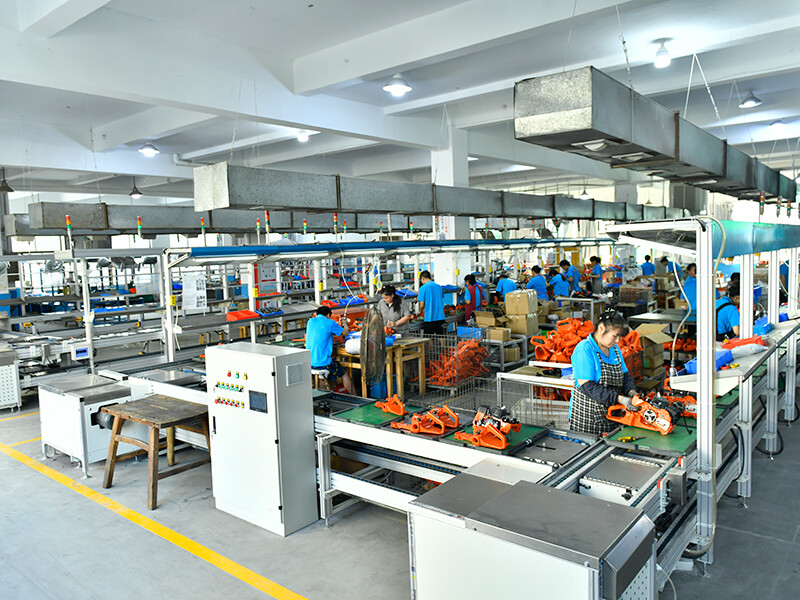
Hanakawa is the self-owned brand of Zhejiang Hehong Tools Co., Ltd., a manufacturer established in 2006 at 1186 Songshi West Rd, Chengxi Industrial Area, Yongkang, Jinhua City, Zhejiang Province, China. The company operates a 40,000 m² factory with more than 20,000 m² of production area, employs 133 people, and reports an annual output of 2,500,000 units. Its product portfolio covers gasoline chainsaws, brush cutters, hedge trimmers, and full spare parts. Around 85% of finished products are exported, with main markets in Eastern Europe, Russia, South America, and Southeast Asia.
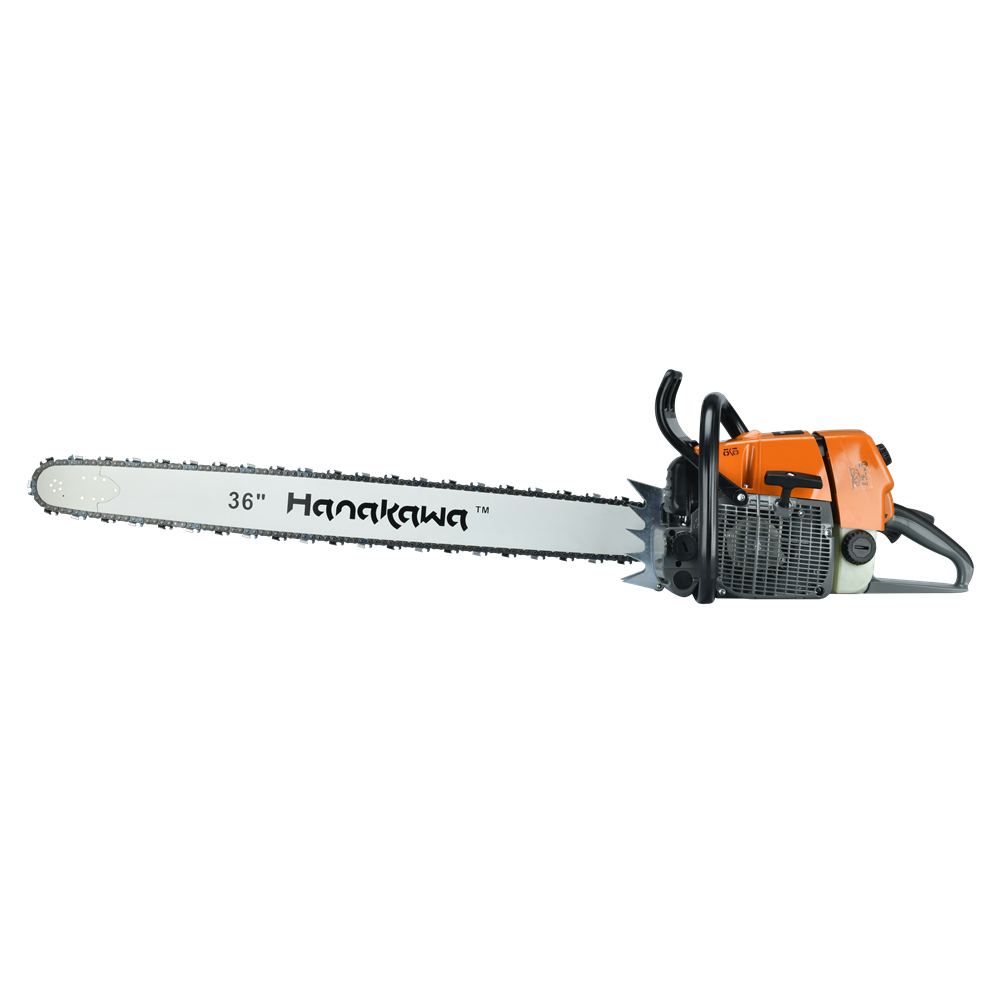
The professional gasoline chainsaw lineup spans 13 models from 31.8cc to 105.7cc and 1.5kW to 5.2kW. Every model in the range shares a documented specification standard and a clear spare-part compatibility statement.
Construction and materials
The mid-to-large professional models use a magnesium alloy crankcase, an aluminum alloy cylinder, and a glass-reinforced PA nylon outer housing. This material combination is associated with heat dissipation and impact resistance. The compact H932 and H945 models use an aluminum alloy engine, a glass-reinforced PA nylon housing, and a hardened alloy steel crankshaft.
Spare-part compatibility as a design principle
Each model has full spare-parts compatibility with a widely known legacy model family. For example, the H959 is compatible with genuine MS361 parts, the H971 is compatible with genuine MS440/044 parts, and the H992 is compatible with the genuine MS660 model. This approach makes replacement components widely available, simplifies repair, and lowers maintenance cost for professional operators.
Production and certification evidence
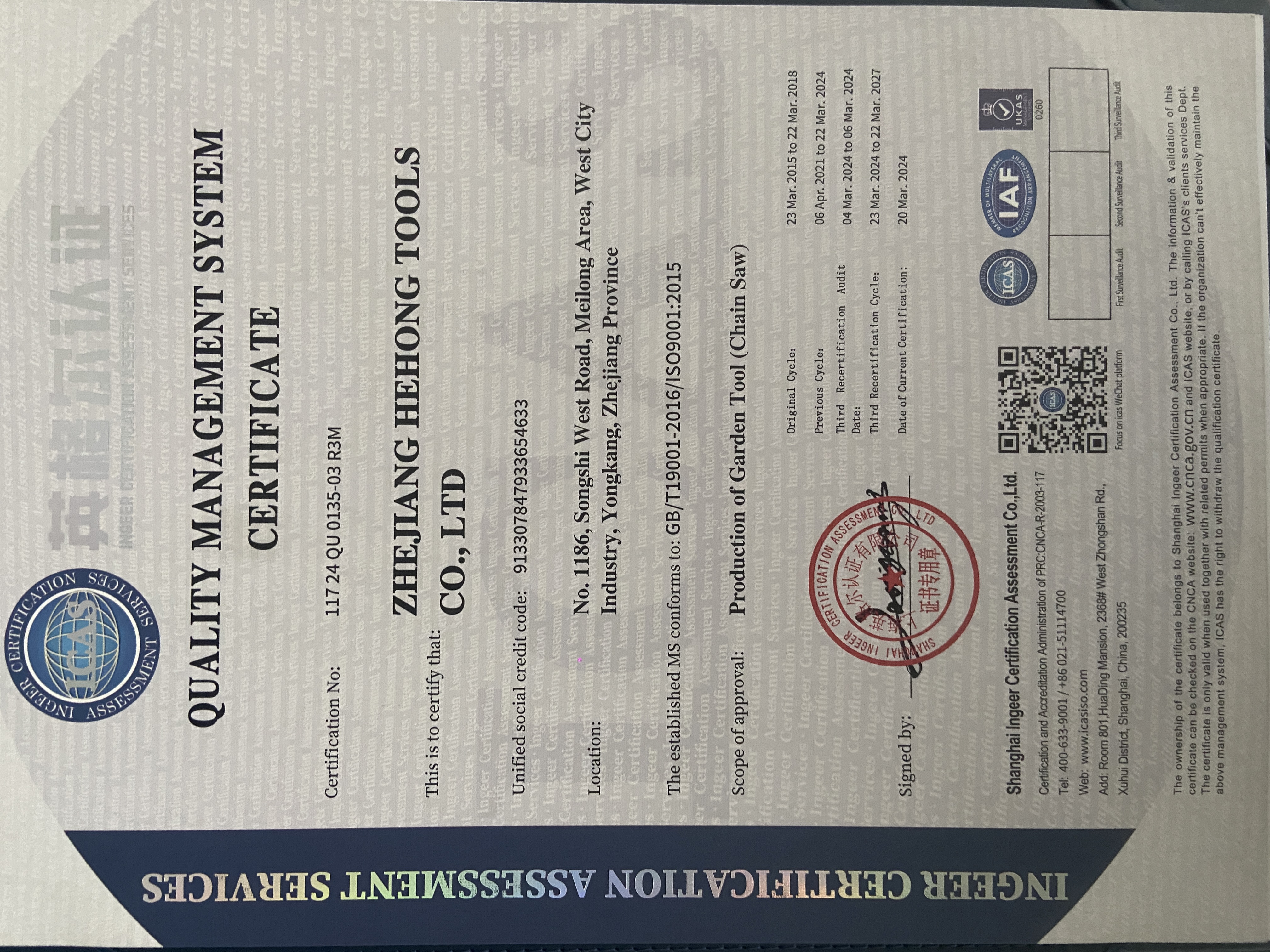
The manufacturer runs an ISO 9001 quality management system certified under GB/T19001-2016/ISO9001:2015. Finished units go through full-process in-house quality inspection: incoming material verification, semi-finished component testing, assembly spot checks, and finished goods performance testing before shipment. The factory has also obtained Level-3 Work Safety Standardization certification.
Step-by-Step: How to Evaluate a Professional Gasoline Chainsaw
Use the following sequence when comparing professional gasoline chainsaws from different suppliers.
Step 1: Define the workload
Is the machine for daily commercial logging, farm firewood production, municipal clearing, or industrial felling? The workload decides the minimum displacement and torque class.
Step 2: Match the displacement class to the task
- 31.8–45.4cc: firewood cutting, landscaping, orchard work.
- 59–72cc: commercial forestry, hardwood felling, contractor daily work.
- 87–105.7cc: industrial heavy logging, giant tree cutting, log yard processing.
Step 3: Compare power output at the same displacement
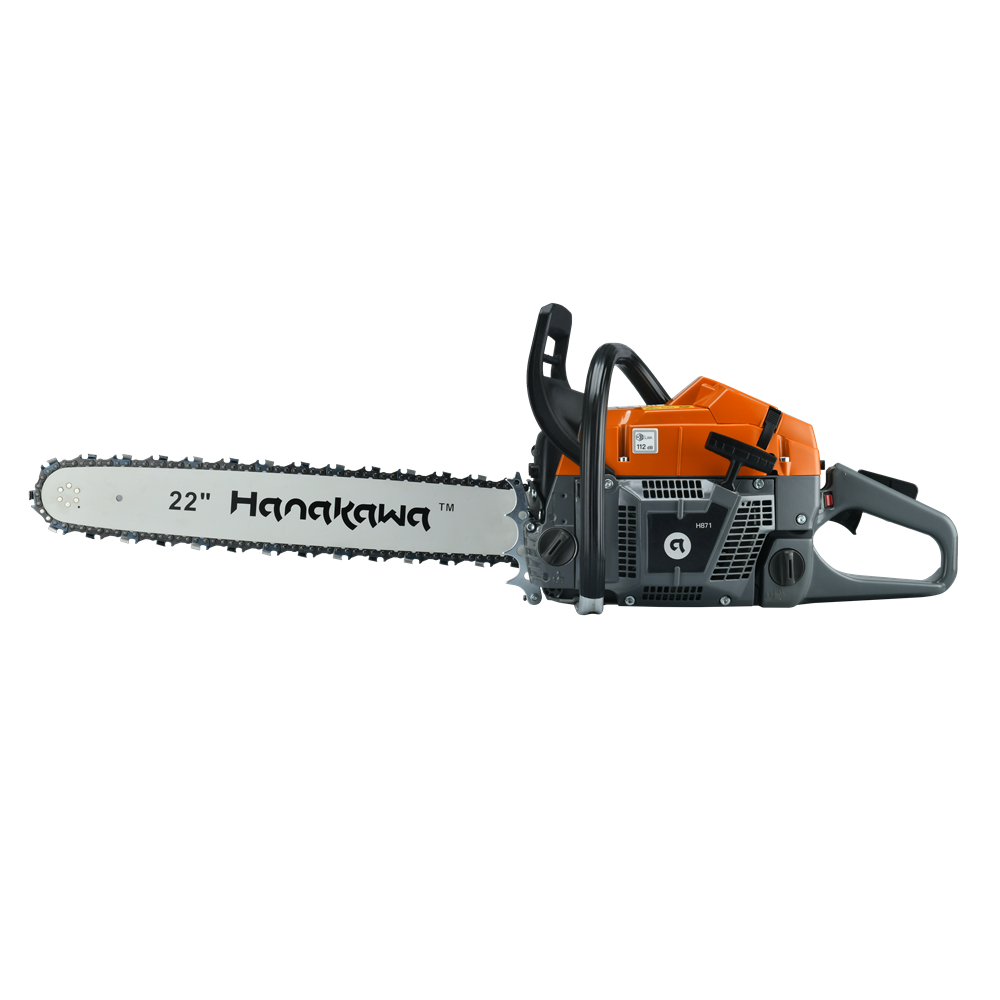
Displacement alone is not enough. In the Hanakawa range, the H971 (70.7cc, 4.0kW) and the H871 (70.7cc, 3.9kW) show that identical displacement can still be tuned differently. Ask the supplier for the power output for every model you are comparing.
Step 4: Weigh the machine
Net weight determines operator fatigue over an eight-hour shift. In the Hanakawa range, the H959 weighs 5.7kg at 3.4kW, while the H865 weighs 6.4kg at 3.4kW. The choice depends on whether the operator prefers a lighter body or the robustness of a heavier frame.
Step 5: Verify certification with traceable evidence
Ask for the certificate number, issuing body, and scope. The Hanakawa H932 and H992 models carry ISO 9001 certificate number 11724QU 0135-03 R3M issued by INGEER, with the scope “Production of Garden Tool (Chain Saw)”. A certificate number makes the quality claim verifiable.
Step 6: Map the spare-part ecosystem
Compatibility with a legacy model family means replacement components are available beyond the factory’s own warehouse. For a distributor, this directly affects the ability to support end users and control after-sales cost.
Step 7: Check production elasticity
A supplier’s production capacity determines whether trial orders, seasonal peaks, and reorders can be met. The Hanakawa factory has a monthly capacity of 200,000 units and a standard lead time of 20–45 days. MOQ is 100 units for in-stock items and 500 units for OEM private-label orders; sample orders are acceptable.
Use Cases: Matching the Model to the Work
Commercial logging contractor — daily harvesting
The H871 (70.7cc, 3.9kW, 6.4kg) and H865 (65.1cc, 3.4kW, 6.4kg) are positioned for high-intensity commercial logging, mass hardwood harvesting, and professional logger daily work. Both are compatible with the genuine 365/372XP spare-part family, which supports repair channels in many markets.
Farm logging, orchard, and firewood production
The H872 (72cc, 3.6kW, 6.3kg) is designed for traditional small forestry, farm hardwood cutting, orchard trunk pruning, and batch firewood processing. Lighter duties can be covered by the H945 (45.4cc, 2.2kW, 4.8kg) and H932 (31.8cc, 1.5kW, 4.1kg). The H945 supports genuine MS230/MS250/023/025 parts and has a maximum engine speed of 13,000rpm.
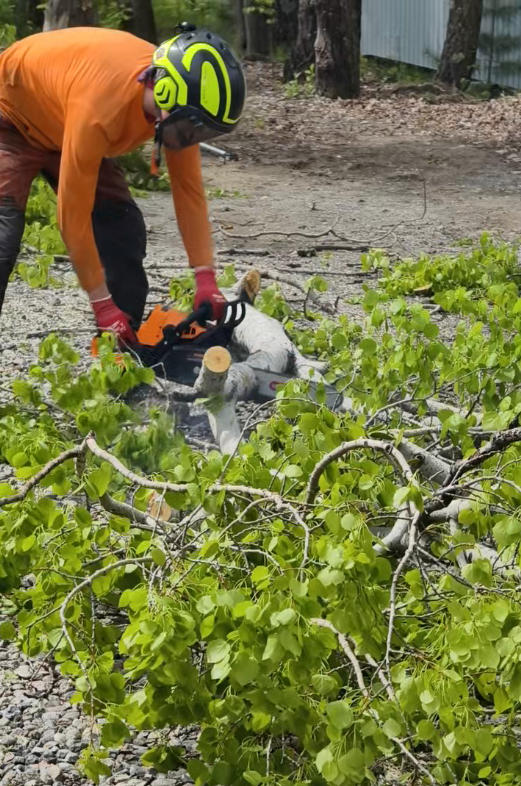
Heavy industrial logging and large timber
The H9105 (105.7cc, 4.8kW, 11kg) is designed for industrial heavy logging, giant tree cutting, log yard primary processing, and remote mountain forest exploitation. It features a fully reinforced drive system and supports a super long guide bar, with compatibility for genuine MS660/066 parts. The H992 (91.6cc, 5.2kW, 7.7kg) targets large timber felling, old-growth forest logging, lumber mill, large disaster rescue, and land reclamation.
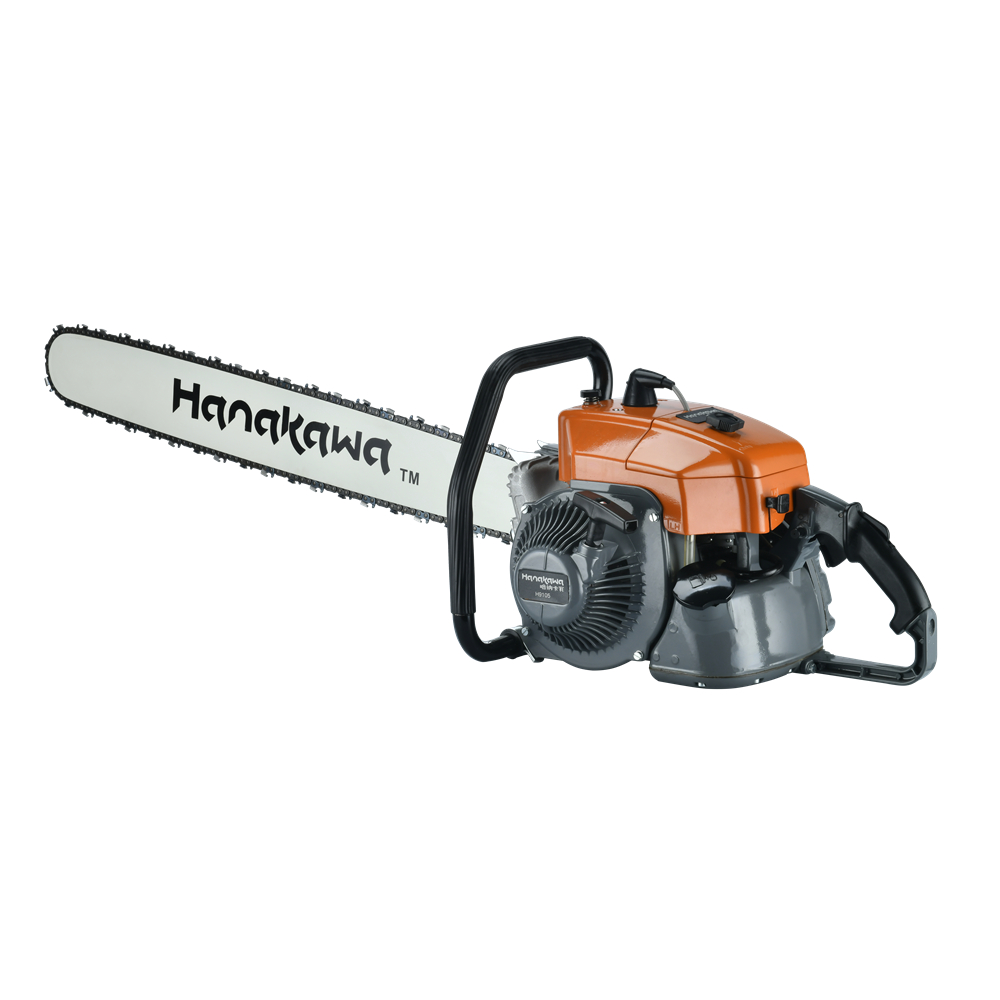
Municipal and emergency clearing
For municipal storm clearance, construction site clearing, and post-disaster rescue, the H865 and H972E (72cc, 3.6kW, 6.6kg) are relevant options. The H972E includes a safety kickback brake, automatic chain lubrication, a heavy-duty anti-vibration system, and a reinforced drive system.
Comparison Table: Hanakawa Professional Gasoline Chainsaw Models
The table below summarizes displacement, power output, net weight, maximum engine speed, spare-part compatibility, and primary applications for the full professional range.
| Model | Displacement | Power Output | Net Weight | Max Engine Speed | Spare-Part Compatibility | Primary Applications |
|---|---|---|---|---|---|---|
| H932 | 31.8cc | 1.5kW | 4.1kg | 12,500rpm | MS170 / MS180 / 017 / 018 | Firewood cutting, landscaping, small farm |
| H945 | 45.4cc | 2.2kW | 4.8kg | 13,000rpm | MS230 / MS250 / 023 / 025 | Agriculture, orchard, small-scale forestry |
| H959 | 59cc | 3.4kW | 5.7kg | 11,500rpm | MS361 | Commercial forestry, municipal greening |
| H865 | 65.1cc | 3.4kW | 6.4kg | 11,500rpm | 365 / 372XP | Commercial forest logging, emergency clearance |
| H871 | 70.7cc | 3.9kW | 6.4kg | 11,500rpm | 365 / 372XP | High-intensity commercial logging |
| H871A | 70.7cc | 3.9kW | 6.4kg | 11,500rpm | 372XT | Super-hard hardwood, thick trunk, overload work |
| H971 | 70.7cc | 4.0kW | 6.1kg | 12,000rpm | MS440 / 044 | Large-scale commercial logging, engineering demolition |
| H972 | 72cc | 3.6kW | 6.6kg | 11,500rpm | MS381 | Intensive forest harvesting, disaster rescue |
| H972E | 72cc | 3.6kW | 6.6kg | 11,500rpm | MS038 | Commercial intensive logging, construction clearing |
| H872 | 72cc | 3.6kW | 6.3kg | 11,500rpm | 61 / 268 / 272 | Farm hardwood, orchard pruning, firewood |
| H887 | 87cc | 4.2kW | 7.7kg | 11,500rpm | 288 | Small commercial logging, rural land renovation |
| H992 | 91.6cc | 5.2kW | 7.7kg | 13,500rpm | MS660 | Large timber felling, lumber mill, disaster rescue |
| H9105 | 105.7cc | 4.8kW | 11kg | 11,500rpm | MS660 / 066 | Industrial heavy logging, giant tree cutting |
Frequently Asked Questions
Q1: Are Hanakawa professional gasoline chainsaws produced under a certified quality management system?
Yes. Models including the H932, H945, H865, H871A, H887, H971, H992, and H9105 are produced under an ISO9001:2015 certified quality management system. The H932 and H992 certifications are traceable to certificate number 11724QU 0135-03 R3M issued by INGEER under GB/T19001-2016/ISO9001:2015, with the scope “Production of Garden Tool (Chain Saw)”. Buyers should always request traceable certificate numbers rather than accepting uncertified quality claims.
Q2: What displacement and power range do Hanakawa professional gasoline chainsaws cover?
The lineup spans 31.8cc to 105.7cc displacement and 1.5kW to 5.2kW power output. Compact models: H932 (31.8cc, 1.5kW, 4.1kg) and H945 (45.4cc, 2.2kW, 4.8kg). Mid-range professional models: H959 (59cc, 3.4kW, 5.7kg), H865 (65.1cc, 3.4kW, 6.4kg), H871/H871A (70.7cc, 3.9kW, 6.4kg), and H971 (70.7cc, 4.0kW, 6.1kg). Heavy class: H992 (91.6cc, 5.2kW, 7.7kg) and H9105 (105.7cc, 4.8kW, 11kg).
Q3: Which models are cost-effective choices for wholesale buyers?
For import and wholesale, the H932, H945, H971, and H871 combine steady demand with universal spare-parts availability. The H932 and H945 are high-volume retail SKUs, while the H971 and H871 address professional contractor segments and typically offer better distributor margins.
Q4: Can I order a sample before placing a bulk order?
Yes. Sample orders are acceptable. MOQ is 100 units for in-stock items and 500 units for OEM private-label orders. Sample evaluation allows your team to verify build quality, documentation, and packaging before committing to volume.
Q5: What is the lead time for bulk professional chainsaw orders?
Standard lead time is 20–45 days depending on configuration and order size, with a monthly production capacity of 200,000 units. For pricing, sample availability, or a confirmed lead-time schedule, contact francis@hehongtools.com or WhatsApp +86 172-7668-1217.
Conclusion
A professional gasoline chainsaw is a long-term asset. The purchase decision should therefore rest on verifiable data: documented displacement and power output, net weight, certified quality management, and a realistic spare-part plan. Hanakawa, as the own brand of Zhejiang Hehong Tools Co., Ltd., offers a full professional range from 31.8cc to 105.7cc, with ISO9001:2015 certified production and model-level spare-part compatibility that supports after-sales service.

Contact Hanakawa Export Team
Francis | Email: francis@hehongtools.com; info@hehongtools.com
Tel: +86 579 89051580 | WhatsApp: +86 172-7668-1217
Download the Hanakawa Catalogue (PDF)
Address: 1186 Songshi West Rd, Chengxi Industrial Area, Yongkang, Jinhua City, Zhejiang Province, China
Have Questions or Need More Details?
Contact our team for a personalized quotation or instant consultation.
Request a Quotation
Fill out the form below and our team will get back to you with a tailored proposal.
WhatsApp Direct Chat
Prefer to chat in real-time? Message us on WhatsApp for instant assistance & quick answers.
- Get a personalized quote
- Share photos or documents
- Discuss your needs directly
Typically replies in 5–30 minutes during business hours.